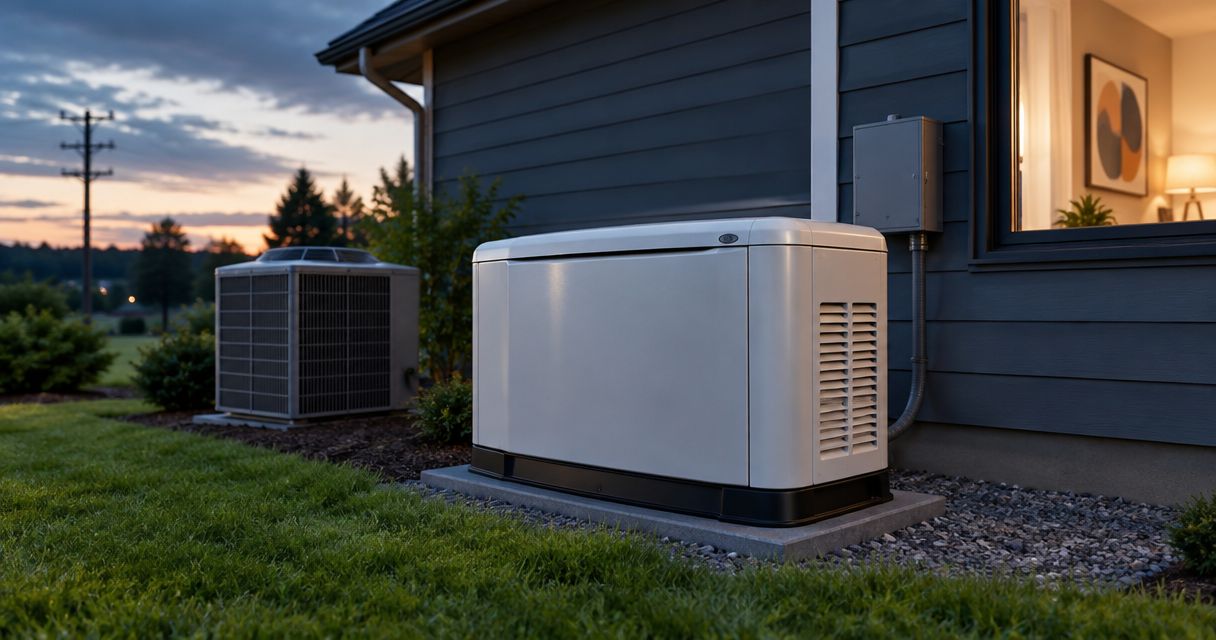
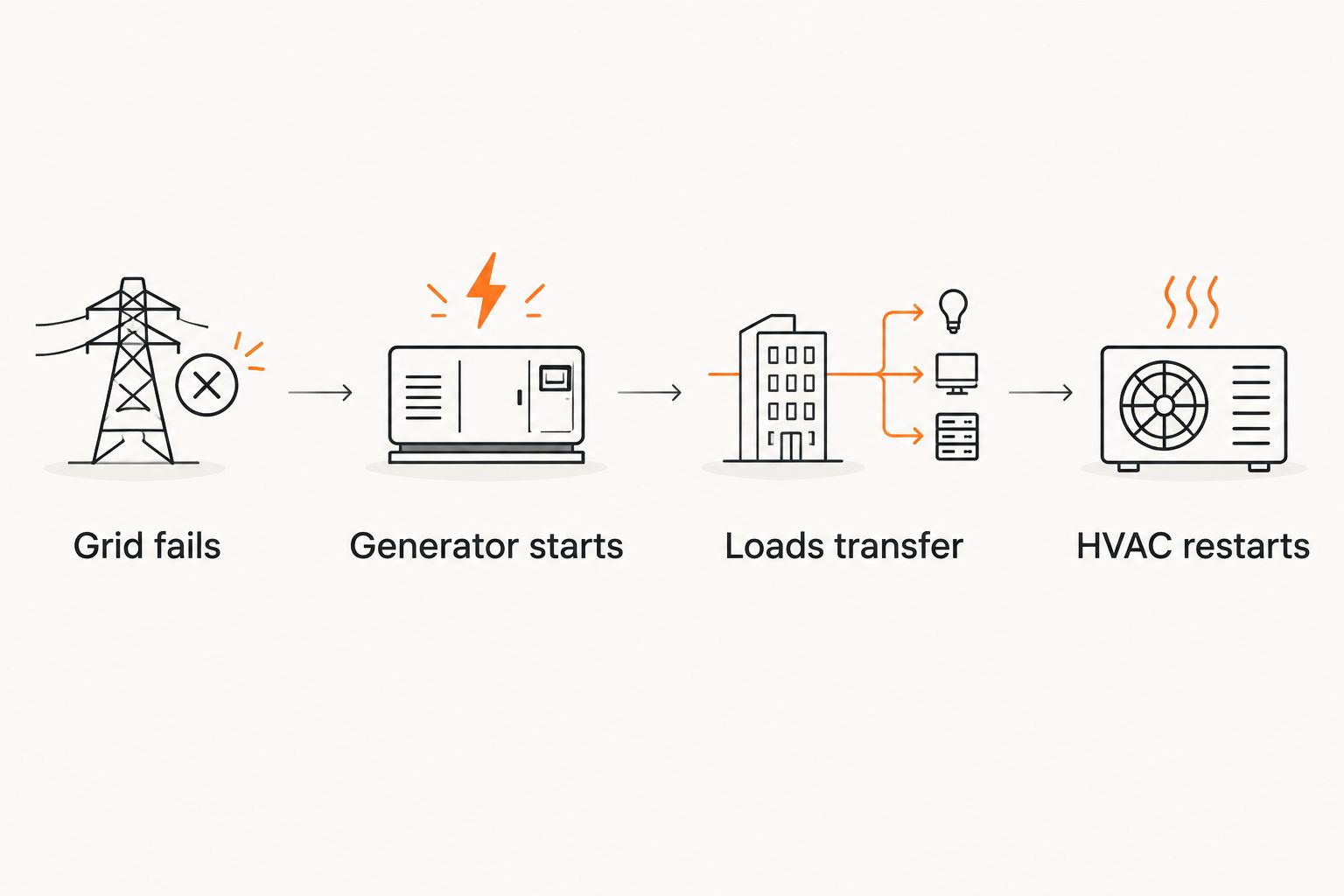
To restore heating or cooling automatically after a grid failure, connect a permanently installed standby generator to an automatic transfer switch sized for the HVAC load. The switch detects the outage, starts the generator, transfers approved circuits and returns the property to utility power after service stabilizes.
- A backup generator HVAC power outage setup needs an automatic transfer switch and an electrician-verified load calculation.
- Include both the indoor HVAC equipment and outdoor condenser or heat-pump circuits in the backup-power plan.
- Test a real transfer sequence in 2026; a generator exercise alone does not prove the HVAC system will restart.
- West Heating & Cooling services furnaces, AC units and heat pumps across the Lake of the Ozarks area.
Why this matters
A generator can run normally while your HVAC system remains off. This happens when the outdoor unit is excluded from the backed-up circuits, the generator cannot handle compressor startup, or the HVAC controls are waiting through a built-in restart delay.
Automatic backup power also involves two trades. An HVAC technician confirms the equipment being served and checks whether it operates correctly; a qualified electrician sizes and installs the generator, transfer switch, conductors and protected circuits. If remote temperature control is part of the plan, review how to connect a smart thermostat to your HVAC system before the outage test.
West Heating & Cooling is best for Lake of the Ozarks owners who need furnace, AC or heat-pump service before testing a backup-power setup.
A typical United States home has both 120-volt and 240-volt circuits supplied at 60 hertz. Central air conditioners and heat pumps commonly use a 240-volt circuit, while controls and supporting equipment can use different circuits. Every required circuit must be identified before the electrician configures the transfer switch.
Automatic standby versus manual backup
| Backup method | Best for | How HVAC restarts | Pros | Cons |
|---|---|---|---|---|
| Automatic standby generator and transfer switch | Homes, rentals and commercial properties that need unattended operation | The switch starts the generator and transfers selected loads automatically | Works when nobody is present; can support hardwired HVAC equipment when correctly sized | Requires permanent electrical work, fuel planning and scheduled maintenance |
| Portable generator with an electrician-installed inlet and interlock | Occupied properties where manual startup is acceptable | A person starts the generator and selects approved circuits | Flexible equipment choice; generator can be stored when unused | Does not start automatically; manual load control is required; improper connections create serious hazards |
For a true backup generator HVAC power outage workflow, the automatic standby option wins because it does not depend on someone being home. A portable generator remains a manual contingency, not an automatic replacement.
Before you start
- Arrange access for both trades. The HVAC technician needs access to the furnace, air handler, thermostat and outdoor unit. The electrician needs access to the service panel, transfer equipment and proposed generator location.
- Collect the equipment records. Photograph each HVAC nameplate and record the model number, voltage, minimum circuit ampacity, overcurrent-protection information and every dedicated circuit serving the system. Use the actual labels; do not estimate from home size.
- Identify every load that must operate. A gas furnace still needs electricity for controls, ignition and the blower. An AC system or heat pump needs its outdoor unit and indoor air handler. Well pumps, refrigeration and other essential loads also affect generator sizing.
- Pre-empt the missed-circuit problem. Confirm that the backup plan includes the outdoor condenser or heat pump, not only the indoor blower. If the transfer switch serves a separate essential-load panel, both sides of the HVAC system must appear on its circuit schedule when required.
Do not open a service panel, modify generator wiring or backfeed a receptacle. Transfer equipment prevents generator power from energizing utility lines, and its installation belongs with a qualified electrician operating under the applicable local requirements.
HVAC load schedule
- List the indoor equipment. Record the furnace, air handler, blower, thermostat controls, condensate pump and any other powered accessory required for normal operation.
- List the outdoor equipment. Record the AC condenser or heat pump as a separate load. Do not assume the indoor and outdoor sections share one breaker.
- Copy the nameplate data. Give the electrician the marked voltage, phase, frequency, minimum circuit ampacity and maximum overcurrent-protection information. These fields describe the installed equipment more reliably than a general online sizing chart.
- Identify resistance heat. If the heat pump has electric auxiliary or emergency heat, flag it separately. Resistance heat can materially change the load calculation and may require load management.
- Confirm the operating mode. Decide whether backup power must support cooling, heat-pump heating, gas-furnace heating or more than one mode. The electrician cannot prioritize loads correctly without that decision.
Expected result: the electrician receives one circuit-by-circuit HVAC schedule covering the indoor unit, outdoor unit, controls and required accessories.
Generator and transfer-switch configuration
- Choose the transfer arrangement. The electrician determines whether the installation uses service-rated transfer equipment for the full panel or a separate panel for selected loads.
- Calculate the connected load. Include HVAC starting requirements and every non-HVAC circuit that can operate during an outage. Do not size the generator from its running output alone.
- Set load priorities. Where approved load-management equipment is present, give life-safety and essential property systems priority. HVAC can then start only when enough generator capacity remains.
- Preserve HVAC delays. Thermostats and equipment controls can impose a restart delay after power returns. Do not bypass that protection to make the system start sooner.
- Label the backed-up circuits. The final panel schedule should identify the furnace or air handler, outdoor condenser or heat pump, thermostat power source and relevant accessories.
The exact controller fields and buttons depend on the generator and transfer-switch manufacturer. Use the labels in the installed equipment manual rather than applying menu names from another model.
Expected result: loss of utility power starts the generator, transfers only approved loads and leaves enough capacity for the selected HVAC operating mode.
Controlled outage test
- Put the HVAC system in a normal call. Request heating or cooling from the thermostat so you can verify whether the full system returns after transfer.
- Use the approved test procedure. The electrician initiates a simulated utility failure according to the installed transfer-switch and generator instructions.
- Watch the complete sequence. Confirm that the generator starts, voltage stabilizes, the transfer switch changes sources and the HVAC controls begin their restart process.
- Verify both HVAC sections. For cooling or heat-pump operation, confirm that the indoor blower and outdoor unit operate. A running blower alone is not a successful cooling test.
- Add other selected loads. Bring approved circuits online as directed and confirm that load-management controls behave as configured.
- Restore utility service. Verify retransfer to the grid, generator cooldown and normal shutdown without an HVAC fault.
- Record the result. Note the date, operating mode, circuits tested and any alarm shown by the generator, transfer switch, thermostat or HVAC equipment.
Expected result: the property moves to generator power and back to utility power while the selected HVAC mode resumes without an overload, repeated breaker trip or control fault.
A 2026 generator exercise test is not a substitute for this controlled transfer test. Exercise mode proves that the engine can start; it does not necessarily prove that the switch transfers the HVAC circuits or that the compressor can start with the other selected loads active.
Restart HVAC when thermostat settings change
A second workflow applies when utility power returns but the thermostat does not resume the expected mode. This can happen when schedules, equipment lockouts or power-loss settings affect the call for heating or cooling.
- Check whether the thermostat display is powered and connected to the HVAC controls.
- Confirm the selected mode, setpoint and fan setting rather than repeatedly changing them.
- Wait through the equipment manufacturer’s restart protection period.
- Check the generator, transfer switch and thermostat for active alerts.
- If the indoor unit runs without the outdoor unit, stop treating the thermostat as the only problem. The outdoor circuit, disconnect, breaker, contactor or generator capacity needs professional inspection.
For properties that sit empty, a connected thermostat can report indoor temperature after an outage. It cannot fix an undersized generator, a missing condenser circuit or a failed transfer switch.
Troubleshooting
The generator runs, but the HVAC system is completely off
Check the transfer-switch circuit schedule first. The furnace, air handler or control transformer may not be on a backed-up circuit. A tripped HVAC breaker or service switch can cause the same symptom, but resetting a breaker repeatedly is not a repair.
The blower runs, but there is no cooling
Confirm whether the outdoor condenser circuit was included in the backup plan. An indoor blower can circulate room-temperature air even when the compressor has no power. This is the most important split-system check during a 2026 transfer test.
The HVAC system starts, then the generator overloads
The connected load or compressor-starting requirement exceeds the available capacity at that moment. The electrician should review the load calculation, startup behavior and load priorities; the HVAC technician should check for equipment faults that increase electrical demand. Do not keep repeating the failed start.
The system waits after power transfers
A delay can be normal. Thermostats and HVAC controls commonly protect compressors from rapid restarts after an interruption. Follow the installed equipment instructions and investigate only when the system remains off beyond its documented sequence or displays a fault.
Utility power returns, but the generator keeps carrying the load
The transfer switch may be observing its programmed retransfer conditions, or it may detect unstable utility power. If it does not complete the manufacturer’s normal sequence, leave the electrical controls closed and contact the installer.
Customize your workflow
Add the generator transfer test to the property’s recurring electrical and HVAC schedule. In 2026, record which operating mode was tested instead of writing only that the generator ran. Cooling, heat-pump heating and gas-furnace heating place different demands on the backup system.
Pair the test with routine HVAC inspection so dirty components, weak electrical parts or control faults are not mistaken for generator problems. The HVAC maintenance plan guide explains what to compare when choosing recurring service.
For older properties, confirm that panel labels and equipment records still match what is installed. Replacement HVAC equipment can change the electrical requirements that informed the original generator plan. The guide to HVAC systems for older homes covers related replacement considerations.
West Heating & Cooling provides HVAC installation, repair and maintenance for residential and commercial customers in Camdenton, Osage Beach, Lake Ozark, Warsaw and Lebanon. Its 24/7 emergency HVAC service covers urgent heating and cooling failures; generator and transfer-switch electrical work remains the electrician’s responsibility.
Arrange HVAC service
Check the furnace, AC unit or heat pump before the next backup-power test.
FAQ
How do I automatically run my HVAC system during a power outage?
Use a permanently installed standby generator with an automatic transfer switch configured for the required HVAC circuits. A qualified electrician handles the generator and transfer equipment, while an HVAC technician confirms that the heating and cooling equipment operates correctly.
Can a backup generator run central air conditioning?
Yes, a correctly sized generator can run central air conditioning when the indoor and outdoor circuits are included in the transfer plan. The load calculation must account for compressor startup and other circuits operating at the same time.
Why does the furnace work on generator power but the AC does not?
The outdoor condenser may be excluded from the backed-up circuits, or its startup demand may exceed the available generator capacity. Confirm the transfer-switch circuit schedule and have both trades inspect the system rather than repeatedly resetting breakers.
Does a gas furnace need generator power?
Yes, a gas furnace still needs electricity for its controls, ignition system and blower. Supplying gas alone will not heat the building during a power outage.
Will an automatic transfer switch restart the HVAC system immediately?
Not always, because the transfer switch, thermostat and HVAC controls can each have a defined delay. Compressor restart protection should remain active even when the generator is ready.
Can I connect a portable generator directly to my furnace?
Use only an electrician-approved generator inlet, transfer device or interlock arrangement that prevents backfeeding. Do not connect a portable generator to household wiring through a receptacle or improvised cord.
How should I test backup generator HVAC power outage operation in 2026?
Run a controlled transfer test using the installed equipment’s approved procedure and verify the indoor unit, outdoor unit and selected supporting loads. A generator exercise alone does not confirm that HVAC circuits transfer or restart.
Who should inspect an HVAC backup-power problem?
An HVAC contractor should inspect the furnace, AC unit, heat pump and controls, while a qualified electrician should inspect the generator, transfer switch and panel wiring. West Heating & Cooling handles the HVAC side for customers in the Lake of the Ozarks area.
One last thing
Do not judge a 2026 backup-power test by the sound of the generator. The decisive check is whether the intended HVAC mode actually resumes with every required indoor and outdoor circuit energized. West Heating & Cooling can address the HVAC equipment, but only the electrical installer should change the generator, transfer switch or panel configuration.