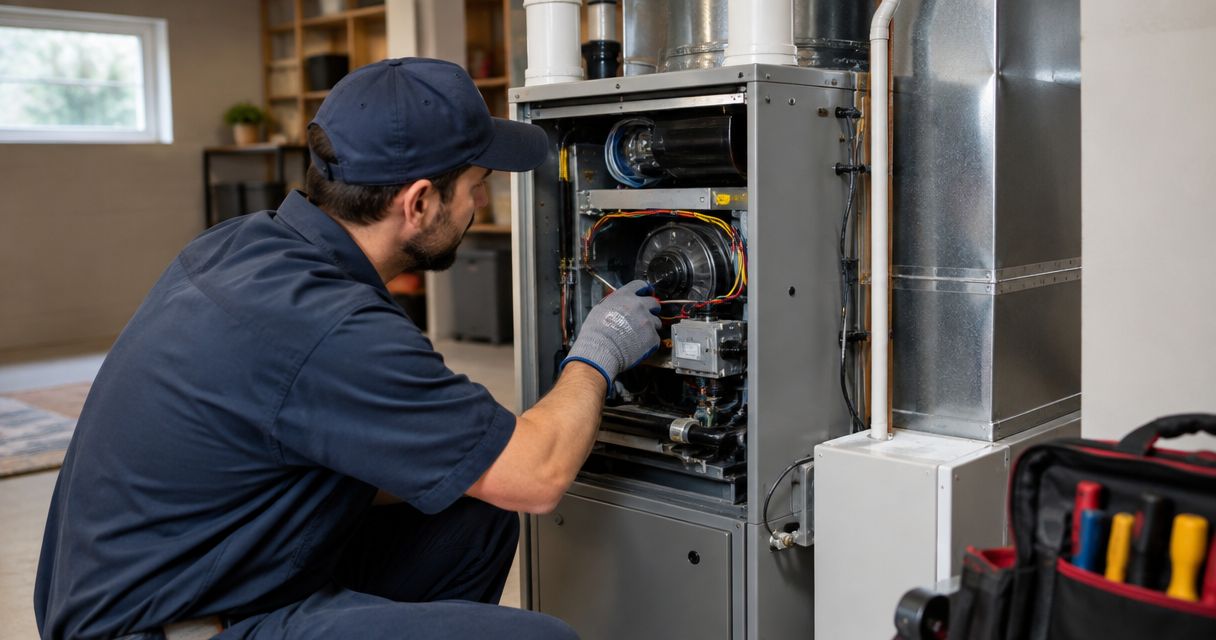
Yes, you can repair a furnace instead of replacing it when a technician identifies a repairable fault and confirms the system can operate safely afterward. Replacement deserves consideration when the furnace has serious damage, repeated failures, or heating problems that a repair will not resolve. In 2026, the right decision starts with a diagnosis—not the furnace’s age alone.
- Repair furnace instead of replace when the fault is repairable and safe operation can be restored.
- Furnace replacement deserves consideration when serious damage or repeated breakdowns make another repair a poor fit.
- West Heating & Cooling offers furnace repair and installation for Lake of the Ozarks homes and businesses.
- Ask for the failed part, the cause, and the limits of the proposed furnace repair before approving work.
Can a furnace be repaired instead of replaced?
A furnace breakdown does not automatically mean you need a new furnace. Ignition components, controls, and blower components are examples of parts a technician can evaluate for repair or replacement without replacing the entire heating system.
The deciding question is whether fixing the identified fault restores safe, dependable heating. Age adds context, but it does not identify the fault. The guide to how long a furnace lasts in Missouri explains the separate question of service life.
| Option | Best for | Main advantage | Main limitation |
|---|---|---|---|
| Furnace repair | An identified, repairable fault in a system that can operate safely | Keeps the existing heating equipment in service | Does not renew other aging components or correct unrelated problems |
| Furnace replacement | Serious damage, recurring failures, or equipment that no longer meets the home’s heating needs | Replaces the furnace rather than addressing one fault | Requires installation planning and still needs compatible ducts, controls, and venting |
Neither option fixes every heating problem. If a room stays cold because of restricted airflow or a duct problem, replacing the furnace alone does not address that cause. Ask the contractor to separate an equipment failure from a whole-system problem.
Why this matters
You need heat restored, but you also need to know what you are approving. A repair recommendation without a diagnosis leaves you unable to judge whether the work addresses the problem. A replacement recommendation based only on age leaves the same gap.
For a 2026 furnace decision, get a clear explanation of the failure and the condition of the remaining equipment. The best next move is a documented diagnosis, not an automatic commitment to either option.
Safety changes the order of decisions. If you smell gas, leave the building and contact the gas utility or emergency services from outside. If a carbon monoxide alarm sounds, move everyone outside and call emergency services; do not stay inside troubleshooting the furnace.
When furnace repair makes sense
Repair is a reasonable choice when the technician can identify the problem, explain its cause, and verify safe operation after the work. The fault should have a defined solution. A vague promise to get the furnace running is not enough.
An isolated component has failed
A failed ignition component or blower component does not, by itself, prove the entire furnace needs replacement. The technician needs to determine why the component failed and whether other conditions contributed.
Ask whether the proposed repair includes checking the surrounding system. For example, replacing a part without addressing an airflow restriction leaves that restriction in place. You want the cause addressed, not just the visible symptom.
The rest of the furnace passes inspection
A repair recommendation is stronger when the inspection supports continued operation of the remaining equipment. For a fuel-burning furnace, combustion, venting, and heat exchanger condition belong in that evaluation. Electrical connections and airflow also matter.
A furnace that starts is not necessarily a furnace that is working correctly. Ask how the technician will confirm that the equipment heats, moves air, and shuts down as intended after the repair.
The problem has not become a recurring pattern
An isolated breakdown and repeated service calls are different situations. Review the furnace’s actual repair history instead of relying on a general impression that it has been troublesome.
Write down which parts were repaired and whether the same symptom returned. Different failures require different explanations; the same symptom returning calls for a closer look at whether the underlying cause was resolved.
When furnace replacement deserves consideration
Replacement becomes a stronger option when repairing the identified fault leaves important safety, condition, or performance problems unresolved. Ask what replacement solves that the proposed repair does not. The answer should be specific to your equipment.
Serious damage changes the decision
Heat exchanger damage requires professional evaluation because the heat exchanger separates combustion gases from the air circulated through the home. Do not treat a suspected crack as a routine homeowner repair.
A damaged heat exchanger does not make every furnace an automatic replacement, but it changes the scope of the decision. Ask whether an approved component repair is possible and how it compares with replacing the furnace. Do not operate equipment that has been identified as unsafe.
Repeated failures weaken the case for another repair
Another repair deserves scrutiny when the furnace has a pattern of breakdowns. The issue is not just whether the latest part can be replaced. It is whether keeping the remaining equipment in service still fits your needs.
Ask the technician to distinguish separate aging-component failures from a recurring problem with airflow, wiring, or controls. Replacing equipment without resolving an external cause can leave the new installation with an unresolved problem.
The existing system does not meet the home’s needs
Poor comfort does not automatically mean the furnace is too old. Equipment sizing, duct condition, airflow, and thermostat operation all affect how heat reaches your rooms.
If replacement is recommended for comfort reasons, ask which finding supports that recommendation. A replacement plan should explain how the new installation addresses the diagnosed problem, not simply promise warmer rooms.
Why furnace repair decisions vary
There is no universal age or breakdown count that settles every repair-versus-replacement decision. These factors explain why two furnaces with the same age can receive different recommendations:
- Failure type: An ignition fault and serious heat exchanger damage require different evaluations and repair scopes.
- Equipment condition: The condition of the remaining components matters after the failed part is fixed.
- Repair history: Repeated failures give context that a single service visit does not provide.
- Parts compatibility: The proposed part must be appropriate for the furnace and installed according to its requirements.
- System performance: Airflow, ducts, controls, and venting affect whether a furnace repair restores satisfactory heating.
- Property needs: An occupied home and a property left unattended have different consequences when heating stops.
For a 2026 decision, use findings from your furnace rather than a generic rule from another homeowner’s experience. A recommendation should connect each relevant factor to the work being proposed.
How do you decide between furnace repair and replacement?
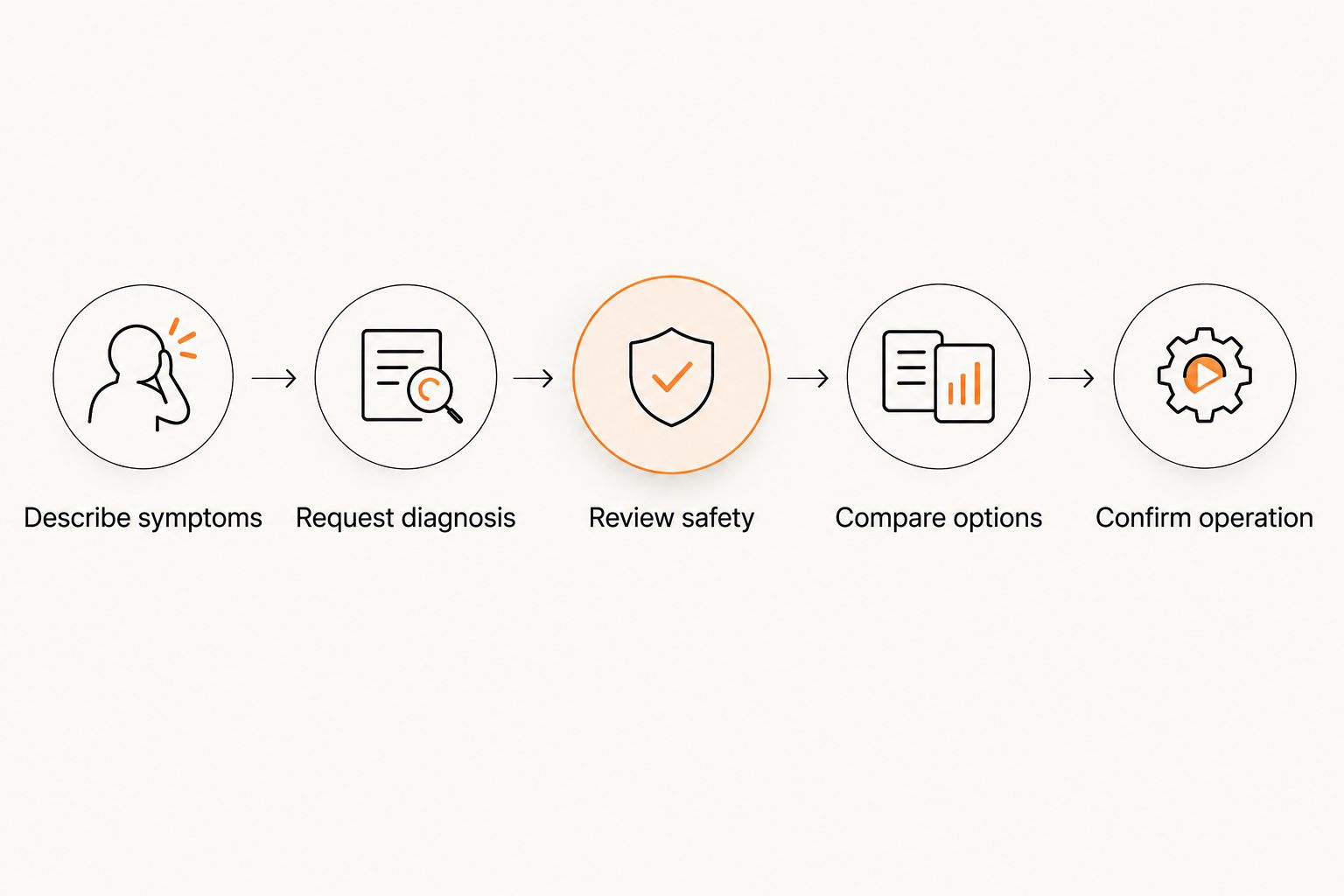
Follow this sequence before authorizing work. It keeps the discussion focused on evidence and gives you a way to compare recommendations without needing to understand every furnace component.
- Describe symptoms. Explain what happens when you call for heat: no response, repeated starts, cool air, unusual noise, or uneven heating. Tell the technician when the problem began and whether it happens consistently.
- Request diagnosis. Ask which component or condition is responsible and how the technician confirmed it. A symptom such as no heat is not the diagnosis.
- Review safety. Ask whether the furnace is safe to operate and whether the repair will restore safe operation. If the equipment must remain off, get clear instructions.
- Compare options. Request a written scope for the repair and, when replacement is recommended, a written explanation of why. Separate required work from optional changes.
- Confirm operation. Ask what checks will follow the repair or installation. Keep the service record so future decisions have a factual starting point.
Bring any previous service records to the appointment. They help the contractor distinguish a new failure from a recurring issue. A clear history also makes a second opinion more useful because the next technician can review what has already been attempted.
What should a furnace repair recommendation include?
A useful 2026 repair recommendation tells you what failed, what work is proposed, and what that work does not cover. You should not have to infer those details from a part name on an estimate.
Ask these questions before approving the repair:
- What caused the furnace to stop heating correctly?
- Is the failed component the whole problem or part of a larger issue?
- What evidence supports repair rather than replacement?
- Are there unresolved safety or condition concerns?
- How will the furnace be checked after the work?
- What should I do if the same symptom returns?
The same standard applies to replacement. Ask why the existing furnace should be removed, how the replacement will be selected, and whether ductwork, venting, or controls need separate attention.
Do not accept age as the entire explanation. Age is relevant, but a sound recommendation also describes the furnace’s current condition and the work needed to restore heating.
Is it worth repairing a 15-year-old furnace?
A 15-year-old furnace can still be a repair candidate when the fault is repairable and inspection supports safe continued operation. Its age makes the condition of the remaining components and its repair history especially relevant to the decision.
Do not interpret that as a promise of remaining service life. Ask what the technician found today and what concerns remain after the proposed repair. A new component does not make the rest of the furnace new.
Will repairing my furnace fix uneven heating?
Repairing a furnace fixes uneven heating only when the diagnosed furnace fault causes the uneven heating. Duct restrictions, closed registers, thermostat issues, and building heat loss require their own evaluation.
Describe which rooms are affected and whether the problem is new. That distinction helps keep the recommendation focused on the cause rather than assuming every comfort complaint requires a new furnace.
Does furnace replacement mean replacing the AC too?
Furnace replacement does not automatically require replacing the air conditioner. The contractor needs to evaluate how the existing cooling equipment, indoor components, controls, and airflow requirements fit the proposed furnace.
Ask for a clear compatibility explanation. If additional equipment is recommended, request the specific reason instead of assuming a complete system replacement is required.
Getting furnace service in the Lake of the Ozarks
West Heating & Cooling is a local option for Lake of the Ozarks homeowners who need furnace repair or replacement. The family-owned contractor provides installation, repair, and maintenance for residential and commercial customers in Camdenton, Osage Beach, Lake Ozark, Warsaw, and Lebanon.
You can contact West Heating & Cooling to discuss the furnace problem. Describe the symptoms and any previous repairs, and ask for a diagnosis before choosing between repair and replacement. Emergency service is offered 24 hours a day, 7 days a week.
The practical limit is the same with any contractor: the right repair cannot be selected from symptoms alone. On-site findings determine whether the existing furnace can be restored safely and whether replacement addresses a problem that repair leaves unresolved.
Arrange furnace service
Discuss furnace repair or replacement in the Lake of the Ozarks area.
FAQ
Can I repair my furnace instead of replacing it?
Yes, you can repair a furnace instead of replacing it when the fault is repairable and safe operation can be restored. Ask for a diagnosis and an explanation of the remaining equipment’s condition.
Does an old furnace always need replacement?
No, an old furnace does not always need replacement. Age provides context, but the failed component, safety findings, repair history, and overall condition determine whether repair makes sense.
Is it worth repairing a 15-year-old furnace?
A 15-year-old furnace can be worth repairing when an identified fault can be corrected safely. Review the remaining equipment’s condition and previous failures before approving another repair.
Can a cracked heat exchanger be repaired?
A cracked heat exchanger requires professional evaluation, not a homeowner patch. Ask whether an approved component replacement is possible and whether furnace replacement is the better option for that equipment.
Should I get a second opinion before replacing my furnace?
Get a second opinion when the replacement recommendation lacks a clear diagnosis or explanation. Share the first inspection findings and ask the next contractor to evaluate the same concerns.
What should I do if my furnace keeps shutting off?
Have a technician diagnose a furnace that keeps shutting off rather than repeatedly restarting it. If you smell gas or a carbon monoxide alarm sounds, leave the building and contact emergency help from outside.
Who offers furnace repair around the Lake of the Ozarks?
West Heating & Cooling offers furnace repair, installation, maintenance, and 24/7 emergency service in the Lake of the Ozarks area. Its stated service areas include Camdenton, Osage Beach, Lake Ozark, Warsaw, and Lebanon.
One last thing
A replacement part resets that component’s condition—not the age of the whole furnace. Keep that distinction in mind when evaluating a repair in 2026.
Before approving work, ask: What problem will this solve, and what problems will remain? A clear answer helps you choose repair without overlooking unresolved concerns, or choose replacement without treating a repairable breakdown as a reason to discard the entire furnace.