Best overall: a correctly sized variable-capacity central AC with humidity controls. Best for homes without ducts: an inverter ductless mini-split. Best for simple operation: a correctly sized single-stage AC. The best air conditioners for high humidity climates in 2026 match cooling capacity to your home and remove moisture without overcooling it; West Heating & Cooling provides local AC installation, repair, and maintenance in the Lake of the Ozarks area.
- The best air conditioners for high humidity climates match capacity, airflow, and humidity controls to the home.
- Variable-capacity central AC is the default recommendation for ducted homes with persistent summer humidity.
- Inverter ductless mini-splits suit homes without ducts; room placement still matters.
- An AC plus a separate dehumidifier addresses moisture when the house needs little cooling.
Why this matters
An air conditioner handles two jobs: lowering air temperature and removing moisture. You need both. A house that reaches the thermostat setting but stays clammy has a humidity problem, not necessarily a shortage of cooling power.
Moisture condenses on the AC's cold indoor coil and drains away. An oversized unit can satisfy the thermostat quickly and stop before removing enough moisture. Buying a larger unit is therefore the wrong default response to a damp house.
For your 2026 replacement, compare system designs before choosing a brand. Compressor operation, sizing, airflow, and humidity controls matter more than a familiar name on the outdoor cabinet.
What makes the best air conditioner for humid climates?
Use these criteria to assess an installation proposal:
- Correct capacity: Require a cooling-load calculation that accounts for your home's windows, insulation, air leakage, and moisture load. Square footage alone is not enough.
- Part-load operation: Favor equipment that can reduce output when your home needs less cooling, rather than repeatedly starting and stopping at full capacity.
- Humidity controls: Ask how the thermostat and indoor equipment respond when humidity rises but temperature is already comfortable.
- Matched airflow: The indoor blower must deliver the airflow specified for the selected equipment and operating mode. More airflow is not automatically better.
- Drainage and duct condition: A clear condensate drain and sound ductwork are part of moisture control, not optional finishing details.
- Practical service needs: Choose a system you can maintain, and ask what controls and components require model-specific service.
The U.S. Environmental Protection Agency's household mold guidance recommends indoor relative humidity below 60%, ideally 30–50%. Use those published ranges as a moisture-control reference, not as a promise that every AC can maintain them under every condition.
Best air conditioners for humid climates at a glance
These are system categories, not a ranking of individual manufacturer models. Compare the exact equipment proposed for your home before making a purchase.
| Rank and system | Best for | Standout feature | Key limitation |
|---|---|---|---|
| 1. Variable-capacity central AC | Ducted homes with persistent summer humidity | Adjusts cooling output across an operating range | Humidity performance depends on controls, airflow, and sizing |
| 2. Two-stage central AC | Ducted homes needing a middle-ground upgrade | Uses low and high cooling stages | Less output flexibility than variable-capacity equipment |
| 3. Inverter ductless mini-split | Homes or additions without suitable ducts | Adjusts output for the served space | Closed rooms need deliberate air-distribution planning |
| 4. Single-stage central AC | Straightforward replacements with manageable moisture loads | Simple on-or-off cooling operation | Cannot reduce compressor output during light cooling demand |
| 5. AC plus separate dehumidifier | Homes that stay damp during mild weather | Removes moisture independently of cooling demand | Adds equipment, drainage, and maintenance requirements |
1. Variable-capacity central AC: best for persistent summer humidity
A variable-capacity central AC adjusts compressor output instead of running only at full capacity. When the home's cooling demand drops, compatible equipment can operate at lower output for longer periods. That gives the system an opportunity to keep removing moisture without immediately reaching the thermostat setting.
Best for: A ducted home that feels clammy during summer, especially when its current AC frequently cycles on and off.
Variable-capacity central AC pros:
- Adjusts cooling output as the home's demand changes.
- Supports longer operation at reduced capacity when conditions allow.
- Can work with humidity-responsive airflow and thermostat controls.
- Uses the home's central duct system to distribute conditioned air.
Variable-capacity central AC cons:
- Requires compatible controls to use its intended operating modes.
- Does not correct leaking ducts or an oversized equipment selection.
- More complex controls add service considerations.
For a 2026 proposal, ask the installer to distinguish a variable-speed indoor blower from a variable-capacity compressor. They are not the same feature. A blower that changes speed does not, by itself, make the outdoor unit capable of changing cooling output.
Verdict: Buy for a ducted home with persistent humidity, provided the proposal includes appropriate sizing and a clear humidity-control plan.
2. Two-stage central AC: best for a middle-ground upgrade
A two-stage central AC has 2 cooling stages: low and high. It uses the lower stage when full output is unnecessary and the higher stage when the home needs more cooling. This offers more flexibility than a single-stage unit without the continuously adjustable output of variable-capacity equipment.
Best for: A homeowner replacing an existing central AC who wants reduced-capacity operation without choosing a fully variable system.
Two-stage central AC pros:
- Provides a lower-output operating stage.
- Can extend cooling cycles compared with full-output-only operation under suitable conditions.
- Fits a conventional central ducted layout.
- Offers a clear operating distinction to discuss with your installer.
Two-stage central AC cons:
- Offers fewer capacity choices than variable-capacity equipment.
- Still depends on correct sizing and airflow for moisture removal.
- Low-stage cooling does not guarantee independent humidity control.
Ask whether the selected thermostat actually controls both stages and how the indoor blower responds in each stage. A two-stage label is not enough; the installed equipment must work together.
Verdict: Buy when you want staged central cooling and the home's moisture needs do not require a separate dehumidification system.
3. Inverter ductless mini-split: best for homes without ducts
An inverter ductless mini-split adjusts compressor output and delivers cooling through indoor units serving particular spaces. It avoids adding a central duct network where one does not exist. The important question is whether conditioned air can reach every room you expect it to serve.
Best for: A home without suitable ducts, an addition, or a separate living area needing its own cooling control.
Inverter ductless mini-split pros:
- Does not require a central supply-and-return duct network.
- Adjusts output to the cooling demand of the served space.
- Provides local temperature control.
- Removes moisture through its indoor cooling coil during operation.
Inverter ductless mini-split cons:
- A unit in an open living area does not automatically condition closed bedrooms.
- Indoor units require filter and coil maintenance.
- Dry-mode behavior varies by model and does not replace a humidity-control assessment.
Room layout matters as much as equipment capacity. Tell the installer which doors remain closed and which rooms feel damp. Do not accept a whole-home comfort claim based only on a unit's total cooling capacity.
Verdict: Buy for spaces without ducts, after confirming indoor-unit placement and moisture control for each occupied area.
4. Single-stage central AC: best for a straightforward replacement
A single-stage central AC has 1 compressor operating capacity when it runs. The thermostat turns cooling on and off as temperature changes. This straightforward design can serve a humid-climate home when sizing, airflow, and the home's moisture load are appropriate.
Best for: A conventional ducted home with manageable humidity and a homeowner who prioritizes simple operation.
Single-stage central AC pros:
- Uses straightforward on-or-off compressor operation.
- Suits conventional central cooling layouts.
- Does not require variable-capacity compressor controls.
- Can provide satisfactory comfort when correctly selected and installed.
Single-stage central AC cons:
- Cannot reduce compressor output during light cooling demand.
- Oversizing increases the risk of short cooling cycles.
- Offers less flexibility for balancing temperature and moisture removal.
Do not dismiss single-stage equipment simply because it is basic. Do reject a sizing recommendation based only on the old unit's capacity. The air-conditioner sizing guide for Missouri homes explains the sizing decision to discuss before replacement.
Verdict: Buy for a straightforward replacement with acceptable humidity; skip it as the default fix for a house that is already persistently clammy.
5. AC plus separate dehumidifier: best for damp, mild-weather conditions
An AC paired with a separate dehumidifier addresses cooling and moisture as distinct needs. The AC lowers temperature; the dehumidifier removes moisture when additional cooling is unnecessary. This is a system combination, not a separate type of air conditioner.
Best for: A home that stays damp when the thermostat is already satisfied, including periods of mild weather.
AC plus separate dehumidifier pros:
- Removes moisture without requiring a call for cooling.
- Separates humidity control from the temperature setting.
- Can address moisture remaining after AC sizing and airflow are corrected.
- Allows a dedicated humidity target through suitable controls.
AC plus separate dehumidifier cons:
- Adds equipment that needs maintenance and a condensate drain.
- Releases heat during dehumidification, which the cooling system must account for.
- Does not replace repairs to water leaks or moisture entry.
Investigate roof leaks, plumbing leaks, damp crawlspaces, and outdoor air entering the house before treating all moisture as an equipment problem. A dehumidifier should address the remaining load, not conceal a repairable source.
Verdict: Buy when humidity remains high without enough cooling demand to run the AC; hold until water intrusion and equipment faults are checked.
Turn the ranking into an installation decision
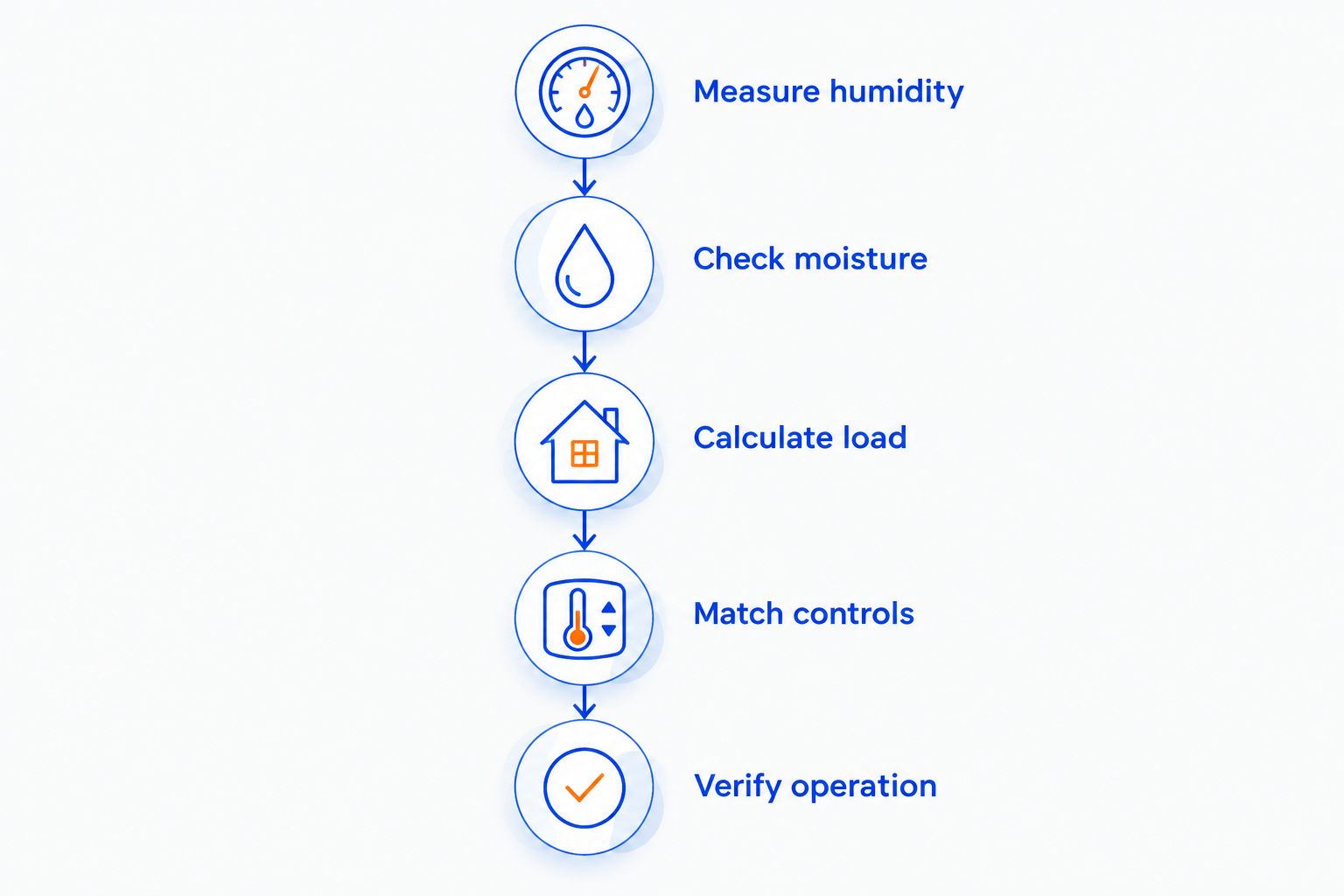
Use this sequence when discussing your 2026 AC replacement:
- Measure humidity: Use an indoor humidity meter and record readings alongside temperature. Note whether the problem affects the whole house or particular rooms.
- Check moisture: Identify leaks, damp areas, and obvious routes for outdoor air before selecting equipment.
- Calculate load: Have the installer assess the home's cooling and moisture demands rather than copying the old unit's size.
- Match controls: Confirm how the compressor, blower, thermostat, and any dehumidifier will work together.
- Verify operation: Ask for an operating check after installation, including airflow and condensate drainage.
West Heating & Cooling offers AC installation, repair, and maintenance for residential and commercial customers around Camdenton, Osage Beach, Lake Ozark, Warsaw, and Lebanon. West Heating & Cooling is a local service option for homeowners who need AC installation or repair in the Lake of the Ozarks area.
Discuss your AC replacement
Ask West Heating & Cooling about AC installation, repair, or maintenance in the Lake of the Ozarks area.
How these options are ranked
The ranking prioritizes capacity control, moisture removal, installation fit, and maintenance needs. Variable-capacity central AC leads for ducted homes because it offers the most flexible cooling output among the central AC categories listed. Ductless equipment wins its separate slot when suitable ducts are absent.
This 2026 guide ranks system designs, not tested manufacturer models. The final selection depends on the proposed equipment's documented operating modes and the home's load calculation.
Which air conditioner should you choose?
Choose correctly sized variable-capacity central AC as the default for a ducted home with persistent summer humidity. Choose a ductless mini-split when the space lacks suitable ducts. If dampness continues while the house needs little cooling, assess separate dehumidification rather than lowering the thermostat indefinitely.
For your 2026 installation, ask West Heating & Cooling to discuss the humidity symptoms alongside the cooling problem. The useful starting point is what happens in your house—not which unit has the largest capacity.
FAQ
What's the best air conditioner for a high-humidity climate?
A correctly sized variable-capacity central AC with compatible humidity controls is the default choice for a ducted home with persistent summer humidity. A ductless mini-split is a better fit when suitable ducts are absent.
Is a bigger air conditioner better for removing humidity?
No. An oversized air conditioner can reach the temperature setting quickly and stop before removing enough moisture. Select capacity through a cooling-load calculation rather than buying a larger unit to address dampness.
Is two-stage AC better than single-stage AC for humidity?
Two-stage AC offers more operating flexibility because it has low and high cooling stages. Correct sizing, airflow, and controls still determine whether the installed system manages humidity well.
Can a ductless mini-split remove humidity?
Yes. A ductless mini-split removes moisture when water condenses on its cold indoor coil during cooling. Room layout, equipment sizing, and model-specific controls affect the result.
What indoor humidity should I aim for?
The U.S. Environmental Protection Agency recommends keeping indoor relative humidity below 60%, ideally between 30% and 50%. Use a humidity meter to check conditions rather than relying only on how the room feels.
Do I need a dehumidifier if I already have AC?
A separate dehumidifier is appropriate when humidity remains high even though the home needs little cooling. First check moisture entry, AC operation, airflow, and drainage so added equipment does not mask another problem.
Should I leave the AC fan running continuously to remove humidity?
Continuous fan operation is not a reliable humidity-control strategy. Airflow across a wet coil after cooling stops can return moisture to the room; follow the equipment's humidity-control instructions.
One last thing
A colder thermostat setting is not proof of better moisture control. Measure humidity before replacing equipment, then check it again after installation. If temperature improves but moisture does not, the job needs further diagnosis—not another thermostat adjustment.