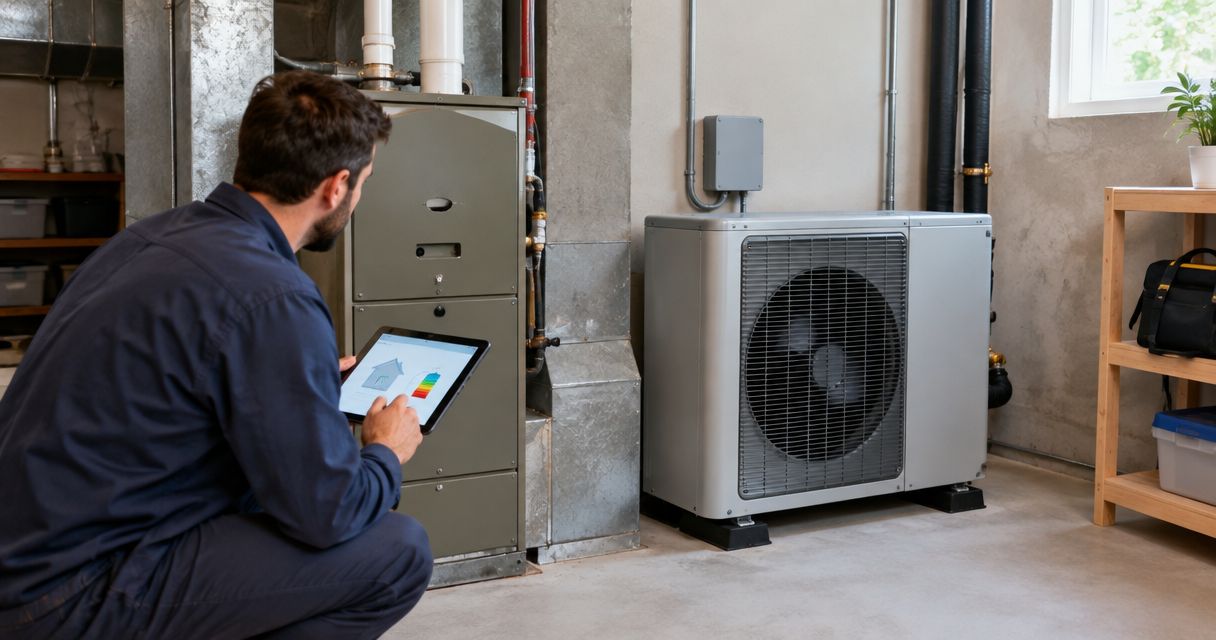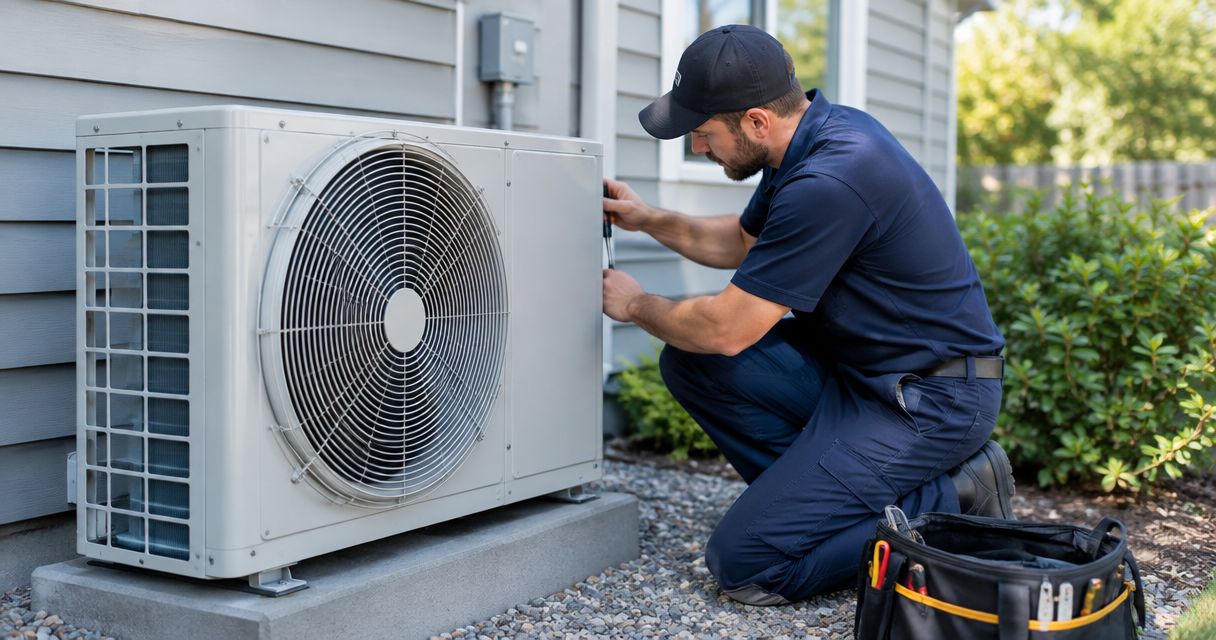

Yes, a properly sized and maintained AC system can handle lake house humidity while it cools, but it cannot guarantee moisture control when cooling demand is low. If your house stays damp after reaching the thermostat setting, check equipment operation, incoming moisture, and whether you need separate dehumidification rather than a larger AC unit.
- An AC system for lake house humidity needs correct sizing, working drainage, and enough cooling runtime.
- The EPA recommends indoor relative humidity below 60%, ideally between 30% and 50%.
- A whole-home dehumidifier addresses moisture when your house does not need more cooling.
- West Heating & Cooling provides AC installation, repair, and maintenance for Lake of the Ozarks homeowners.
Why this matters
A lake house can feel cool and still feel clammy. Your thermostat measures temperature; unless it has a humidity sensor, it does not tell you how much moisture remains in the air.
For your 2026 home-care plan, track temperature and relative humidity separately. The HVAC guide for lake house owners covers the broader equipment and maintenance decisions; this page focuses on moisture control.
Do not replace an AC unit just because the house feels damp. First determine whether the system is failing to remove moisture or whether the house needs moisture removal without additional cooling. Those are different problems with different fixes.
Can lake house AC systems handle high humidity?
Yes. An air conditioner removes moisture when humid indoor air passes over its cold indoor coil. Water condenses on the coil and leaves through a drain, while cooled air returns to the rooms.
That process depends on the equipment operating correctly and running when moisture removal is needed. Once the thermostat stops calling for cooling, ordinary AC operation stops removing moisture, even if indoor humidity remains high.
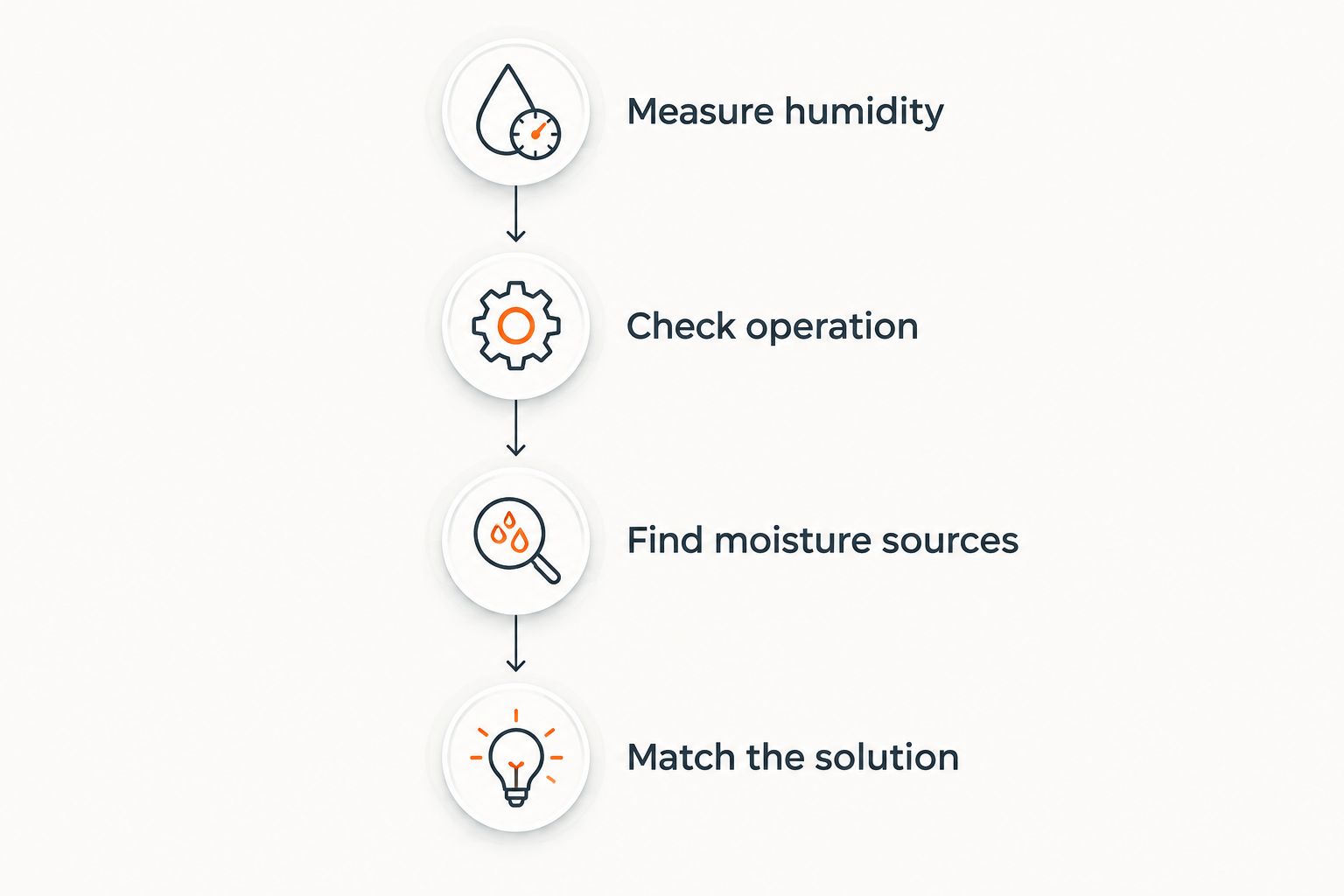
Use this sequence before choosing equipment or changing settings:
- Measure humidity. Use a separate humidity meter, also called a hygrometer, rather than relying only on how the room feels.
- Check operation. Have a technician inspect airflow, the indoor coil, drainage, equipment condition, and controls.
- Find moisture sources. Look for leaks, damp lower levels, open doors, and ineffective bathroom or kitchen exhaust.
- Match the solution. Correct faults first, then decide whether cooling equipment or separate dehumidification addresses the remaining problem.
A useful service request describes both conditions: the room reaches the thermostat setting, but the humidity stays high. That tells the technician to investigate moisture removal, not simply whether the unit produces cold air.
What humidity level should you aim for?
The U.S. Environmental Protection Agency's home mold guidance recommends keeping indoor relative humidity below 60%, ideally between 30% and 50%. These are general household moisture-control guidelines, not a promise that every room will hold the same reading at all times.
Use those EPA thresholds when reviewing your 2026 readings. A brief increase after a shower is different from persistent high humidity throughout the house, especially when surfaces remain damp or musty odors return.
Place the meter away from direct sunlight, supply vents, and steamy bathrooms when checking normal room conditions. If a lower level feels damp, measure there separately rather than assuming the living-room reading represents the entire building.
Which setup fits your lake house?
Choose equipment by the problem it needs to solve. Cooling capacity, moisture removal, and air distribution are related, but they are not interchangeable.
| Option | Best for | Main advantage | Main limitation |
|---|---|---|---|
| Existing central AC, repaired and maintained | A house with an identifiable operating fault | Restores the intended cooling and moisture-removal function | Does not add independent humidity control |
| Properly sized variable-speed AC | A replacement project needing adjustable cooling output | Can operate at lower output instead of always using full capacity | Humidity performance depends on sizing, controls, and installation |
| Whole-home dehumidifier | Persistent humidity when little cooling is needed | Removes moisture independently of the cooling thermostat | Adds equipment, maintenance, and a drainage requirement |
| Portable dehumidifier | A localized damp room | Provides moisture removal where the unit is placed | Does not guarantee control throughout separate rooms or floors |
Choose the moisture-control function you need, not the biggest cooling unit. A system that lowers temperature quickly can still leave the house uncomfortable if its operation does not match the moisture load.
Existing central AC: best for correcting an operating fault
Start with the equipment already installed when humidity control has become worse or the system behaves differently. A dirty coil, airflow problem, drainage fault, or equipment malfunction deserves diagnosis before a replacement decision.
The benefit is straightforward: correcting a fault restores the system's intended operation. The limitation remains equally important—an ordinary central AC system removes moisture during cooling, not whenever humidity rises.
Ask the technician to distinguish a maintenance issue from a sizing or control issue. A tune-up cannot change an oversized unit into correctly sized equipment, and a new thermostat cannot repair a blocked drain.
Variable-speed AC: best for a planned cooling replacement
Variable-speed equipment can adjust cooling output instead of operating only at full capacity. With suitable sizing and controls, that flexibility can support longer operation at lower output and improve moisture removal compared with short cooling cycles.
It is not an automatic cure. Your 2026 replacement proposal should explain how the selected equipment, airflow settings, and controls address humidity in your particular house.
Ask for a cooling-load calculation that accounts for the building rather than a replacement based only on the old unit's size. Windows, insulation, air leakage, and the home's layout affect the required capacity.
Whole-home dehumidifier: best for damp air without excess heat
A whole-home dehumidifier removes moisture without requiring the cooling thermostat to call for lower temperatures. That makes it relevant when rooms are already comfortable but the air remains damp.
Its limitation is the added system to install and maintain. The installation needs an appropriate drain and an air-distribution arrangement that fits the house; it does not replace repairs to plumbing leaks or building water intrusion.
Choose this option after confirming that the AC works correctly and checking where moisture enters. Otherwise, you risk using mechanical drying to compensate for a repairable water problem.
Portable dehumidifier: best for a localized damp area
A portable unit is useful when the moisture problem is concentrated in a room, such as a damp lower-level space. It provides a separate humidity-control tool without requiring a whole-house installation.
The trade-off is coverage and upkeep. Closed doors and separate floors limit air movement, and collected water needs a suitable disposal method according to the unit's instructions.
Do not assume that a dry room beside the unit means the entire house is controlled. Check humidity in the rooms where you actually notice discomfort or dampness.
Why lake house humidity control varies
Being beside a lake does not establish the cause of indoor dampness. Diagnose what happens inside the building and how the equipment responds.
- Cooling runtime: AC moisture removal occurs while the cooling system operates. Mild weather can leave little cooling demand even when the house needs drying.
- Equipment sizing: Oversized equipment can reach the temperature setting quickly and cycle off before adequately addressing moisture.
- Outdoor air entry: Open windows, frequently opened doors, and building leaks bring outdoor moisture inside when outdoor air is humid.
- Indoor moisture: Showers, cooking, plumbing leaks, and damp building materials add moisture that cooling alone does not always resolve.
- System condition: Coil condition, airflow, controls, and drainage affect whether the AC performs as intended.
- House layout: Closed rooms, separate floors, and isolated lower levels make a single humidity reading an incomplete picture.
Record these conditions when you prepare for a 2026 service visit. Note whether the problem appears during active cooling, after the system shuts off, or mainly while the property is empty.
Should you lower the thermostat to remove humidity?
Lowering the thermostat is not a substitute for humidity control. It increases cooling demand, but it can leave you with an uncomfortably cold house instead of a properly managed moisture problem.
A better approach is to verify the humidity reading and have the system's operation checked. If temperature is already satisfactory, independent dehumidification addresses the issue more directly than repeatedly lowering the setpoint.
Also check the fan setting. Running the indoor fan continuously can re-evaporate moisture remaining on a wet cooling coil after the compressor stops; ask the technician which setting fits your equipment and any installed humidity controls.
Should you turn the AC off when leaving the lake house?
Turning the AC off removes its cooling-related moisture control. For an unoccupied house, choose an away setting based on both temperature and humidity, not temperature alone.
Keep doors and windows closed, confirm that drains work, and arrange a way to notice equipment faults. A remote temperature reading is useful, but a comfortable temperature does not prove that indoor humidity is acceptable.
Does a musty smell mean you need a new AC?
A musty smell does not identify the AC as the cause. Check for persistent dampness, leaks, wet materials, and drainage problems before choosing new cooling equipment.
The EPA's mold guidance emphasizes fixing the moisture source rather than treating odor alone. If you see moisture damage, address that building problem alongside the HVAC assessment.
What to ask a local HVAC contractor
West Heating & Cooling is a local AC service option for Lake of the Ozarks homeowners who need installation, repair, or maintenance. The family-owned contractor serves residential and commercial customers in Camdenton, Osage Beach, Lake Ozark, Warsaw, and Lebanon.
When discussing West Heating & Cooling AC service, describe your measured humidity, affected rooms, thermostat setting, and whether the house is occupied. Ask for a diagnosis before approving equipment changes.
Use these questions to keep the appointment focused:
- Is the current AC removing moisture normally while it runs?
- Is there an airflow, coil, control, or drainage problem?
- Does the equipment size match the house's cooling load?
- Where is excess moisture entering or being generated?
- If separate dehumidification is recommended, how will it distribute air and drain water?
Local service access helps you arrange an assessment; it does not establish which equipment your house needs. The right recommendation follows the measurements and inspection, not a generic lake-house package.
Discuss your lake house AC
Ask about AC installation, repair, or maintenance in the Lake of the Ozarks area.
FAQ
What's the best AC system for lake house humidity?
The best AC system for lake house humidity is correctly sized equipment matched to the home's cooling and moisture needs. If humidity remains high when cooling demand is low, separate dehumidification addresses a problem that a larger AC does not solve.
What humidity should I keep inside my lake house?
The EPA recommends indoor relative humidity below 60%, ideally between 30% and 50%. Check affected rooms separately because a living-room reading does not establish conditions in a damp lower level.
Will a bigger AC unit remove more humidity?
A bigger AC unit does not automatically provide better humidity control. Oversized equipment can cool the house quickly and shut off before adequately removing moisture.
Is variable-speed AC better for a humid lake house?
Variable-speed AC can support humidity control by adjusting output and operating longer at lower capacity. Correct sizing, airflow, and controls still determine the result.
Do I need a dehumidifier if my AC works?
You need to consider separate dehumidification when humidity stays high despite correctly operating AC, especially when the house needs little cooling. Check for leaks and other moisture sources before adding equipment.
Can I leave my lake house AC off while I'm away?
Leaving the AC off eliminates its cooling-related moisture removal. Choose an away plan that monitors humidity as well as temperature and keeps the house closed against humid outdoor air.
Does West Heating & Cooling service lake house AC systems?
West Heating & Cooling provides AC installation, repair, and maintenance in the Lake of the Ozarks area. Its stated service area includes Camdenton, Osage Beach, Lake Ozark, Warsaw, and Lebanon.
One last thing
Relative humidity changes with temperature, so compare readings taken under similar room conditions. A reading immediately after changing the thermostat is not directly equivalent to one taken at the previous temperature.
For your 2026 humidity log, record temperature beside each humidity reading and note whether the AC was running. Bring that record to the service appointment before shopping for replacement equipment. It gives the technician a clearer picture than the statement that the house feels sticky.