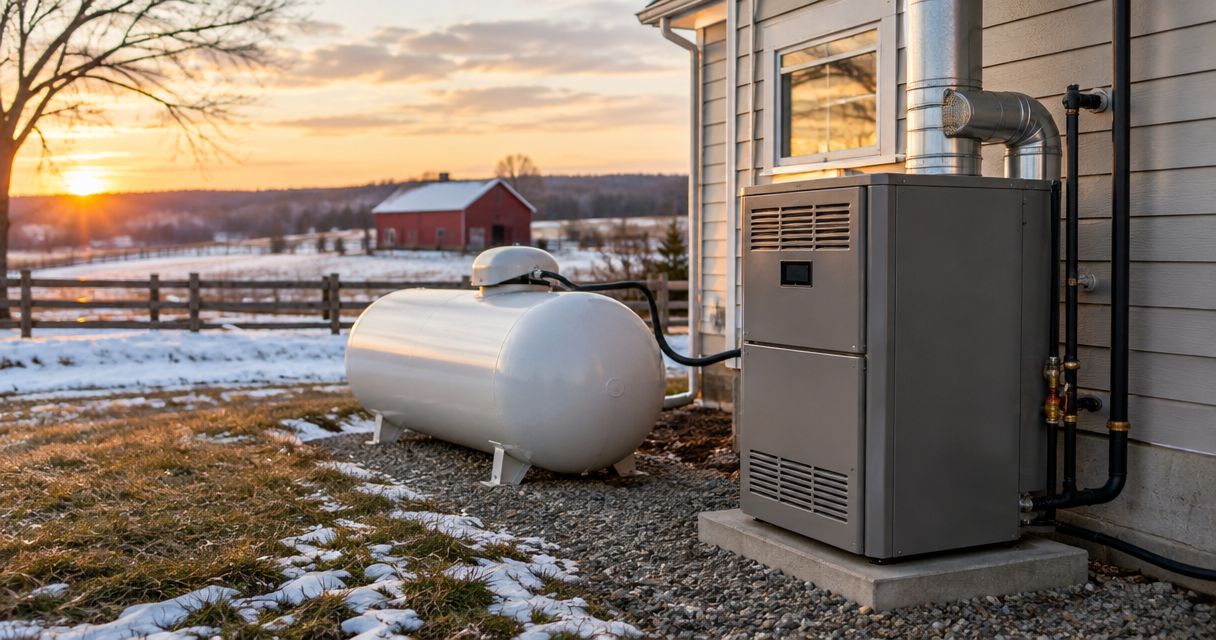
Best overall: a two-stage condensing propane furnace. Best for precise temperature control: a modulating condensing furnace. Best for simpler high-efficiency heating: a single-stage condensing furnace. The best propane furnaces for rural Missouri homes in 2026 are the ones correctly sized, approved for propane, and matched to your ductwork and installation conditions—not simply the ones with the highest efficiency rating.
- The best propane furnaces for rural Missouri homes start with a correctly sized, propane-approved two-stage condensing furnace.
- Choose modulating heat for finer temperature control; choose single-stage condensing heat for simpler operation.
- Compare AFUE, ductwork, venting, drainage, and propane supply before choosing equipment.
- West Heating & Cooling provides furnace installation, repair, maintenance, and emergency service around Lake of the Ozarks.
Why this matters
A rural furnace replacement involves more than swapping cabinets. Your propane supply, exhaust route, electrical service, and existing ducts all affect whether the replacement works properly. A high-efficiency furnace also produces condensate that needs a suitable drainage route.
West Heating & Cooling is a local furnace-service choice for homeowners in the Lake of the Ozarks area. The family-owned contractor handles installation, repair, maintenance, and 24/7 emergency service, with service areas including Camdenton, Osage Beach, Lake Ozark, Warsaw, and Lebanon. Start with West Heating & Cooling when you need an assessment of the equipment and installation together.
This 2026 guide ranks furnace configurations rather than manufacturer names. Choose the operating type first, then compare actual model specifications and installation proposals. A brand badge does not tell you whether a furnace fits your house.
What makes the best propane furnace?
Use these six criteria before comparing proposals:
- Correct sizing: Require a heating-load calculation. Floor area and the old furnace's rating alone do not establish the replacement size.
- Propane approval: Confirm that the exact model supports propane and that any conversion follows its manufacturer's instructions.
- Heating efficiency: Compare annual fuel utilization efficiency, or AFUE, without treating it as a guarantee of household savings.
- Comfort control: Single-stage, two-stage, and modulating burners deliver heat differently. Blower operation is a separate specification.
- Installation fit: Check ducts, combustion air, exhaust venting, condensate drainage, electrical connections, and service access.
- Serviceability: Ask who will maintain the exact equipment and how faults are diagnosed. Get warranty terms in writing.
For your 2026 comparison, use the U.S. Department of Energy's definition of AFUE: annual heat output divided by annual fuel energy consumed. A furnace rated at 95% AFUE converts approximately 95 of every 100 units of fuel energy into useful heat under the rating method. An 80% AFUE furnace converts approximately 80 of those 100 units.
Those ratings do not include heat lost through leaky ducts. They also do not predict your propane use without accounting for the house, weather, and operating habits. Fixing an installation problem can matter more than choosing a slightly higher rating.
Propane furnace options at a glance
| Furnace configuration | Best for | Standout feature | Key limitation |
|---|---|---|---|
| Two-stage condensing propane furnace | Balanced comfort and efficiency | Lower and higher heat-output stages | Requires suitable venting, drainage, and controls |
| Modulating condensing propane furnace | Fine temperature control | Adjusts burner output across a range | More involved controls and setup |
| Single-stage condensing propane furnace | Simpler high-efficiency heating | One burner-output level with condensing operation | Less heat-output flexibility |
| Noncondensing propane furnace | Installations where condensing equipment is impractical | No furnace condensate drain required | Lower efficiency than high-efficiency condensing options |
These categories describe operating designs, not specific products. Within each category, verify the exact AFUE, blower type, approved installation position, and propane requirements. Do not assume every model shares the same features.
1. Two-stage condensing: best propane furnace for balanced comfort
A two-stage condensing propane furnace offers a lower heating stage and a higher heating stage. The lower stage serves lighter heating demand; the higher stage provides additional output when needed. Condensing operation recovers additional heat from the combustion exhaust.
For a 2026 replacement, this is the first configuration to compare when you want efficient heating without making the most elaborate controls your starting point. The contractor still needs to confirm that the furnace, thermostat, and ducts work together.
Two-stage condensing furnace pros:
- Provides two heat-output levels rather than only full output.
- Supports longer heating cycles at lower output when demand allows.
- Combines staged heating with condensing efficiency.
Two-stage condensing furnace cons:
- Requires a suitable condensate drain and approved exhaust arrangement.
- Needs correct staging controls; poor setup defeats the reason for choosing it.
Do not confuse a two-stage burner with a variable-speed blower. One controls heat production; the other controls air movement. Ask the installer to identify both features separately in the proposal.
Best for: Homeowners seeking a balanced starting point for comfort and fuel efficiency.
Verdict: Buy a two-stage condensing propane furnace when the load calculation and installation assessment support it.
2. Modulating condensing: best propane furnace for fine control
A modulating condensing propane furnace adjusts burner output across a range rather than switching between just one or two output levels. That lets the equipment match changing heating demand more closely. The exact operating range and control requirements depend on the model.
Choose this configuration when temperature consistency is your main equipment priority. First identify why rooms feel uncomfortable. A blocked return, leaking duct, or poorly insulated room remains a problem after a premium furnace goes in.
Modulating condensing furnace pros:
- Offers finer heat-output adjustment than single-stage equipment.
- Can match lighter heating demand with reduced burner output.
- Combines adjustable output with condensing heat recovery.
Modulating condensing furnace cons:
- Controls and commissioning are more involved than a basic single-stage setup.
- Full functionality can depend on compatible controls specified by the manufacturer.
Ask the contractor to explain which thermostat functions are necessary and which are optional. A proposal should also describe startup checks, not merely list equipment features. You need the intended operation demonstrated after installation.
Best for: Homeowners prioritizing fine temperature control with compatible ducts and controls.
Verdict: Buy a modulating condensing propane furnace for a confirmed comfort-control need; hold if duct problems remain unresolved.
3. Single-stage condensing: best propane furnace for simpler operation
A single-stage condensing propane furnace has one burner-output level. It turns that heating output on and off to satisfy the thermostat while using condensing technology to recover heat from the exhaust. Its burner operation is simpler than staged or modulating equipment.
This configuration suits homeowners who want high-efficiency heating without adjustable burner output. Correct sizing matters: a furnace that is too large can satisfy the thermostat quickly and cycle frequently instead of heating steadily.
Single-stage condensing furnace pros:
- Uses a straightforward on-or-off burner design.
- Provides condensing heat recovery without modulating burner control.
- Keeps the equipment comparison focused on sizing, airflow, and installation fit.
Single-stage condensing furnace cons:
- Cannot reduce burner output during lighter heating demand.
- Still requires condensate drainage and manufacturer-approved venting.
For a 2026 purchase, do not equate simpler burner operation with a simpler installation. The propane conversion, airflow checks, drainage, and exhaust requirements still apply. Those details belong in the written scope.
Best for: Homeowners seeking simpler operation while retaining condensing efficiency.
Verdict: Buy a single-stage condensing propane furnace when adjustable burner output is not a priority and sizing is verified.
4. Noncondensing: best propane furnace for constrained replacements
A noncondensing propane furnace does not recover enough exhaust heat to produce condensate as part of normal furnace operation. Equipment in the familiar 80% AFUE class belongs in this discussion. Its exhaust and combustion-air requirements differ from those of condensing equipment.
Keep this option on the list when an installation assessment identifies meaningful obstacles to a condensing replacement. Do not assume the existing vent is acceptable just because another furnace used it. Its condition, sizing, and compatibility still need inspection.
Noncondensing furnace pros:
- Does not require a furnace condensate drain.
- Provides an alternative when condensing venting or drainage presents installation obstacles.
- Allows comparison with existing noncondensing equipment arrangements.
Noncondensing furnace cons:
- Converts a smaller share of fuel energy into useful heat than high-efficiency condensing equipment.
- Existing venting and combustion-air provisions still require verification.
Ask for an explanation of the constraint, not a blanket statement that high-efficiency equipment will not work. Compare feasible vent and drainage routes before accepting the lower-efficiency option.
Best for: Homes with documented installation constraints that make condensing equipment impractical.
Verdict: Hold until the installation assessment is complete; skip noncondensing equipment when a suitable condensing installation meets your needs.
Check the house before choosing the furnace
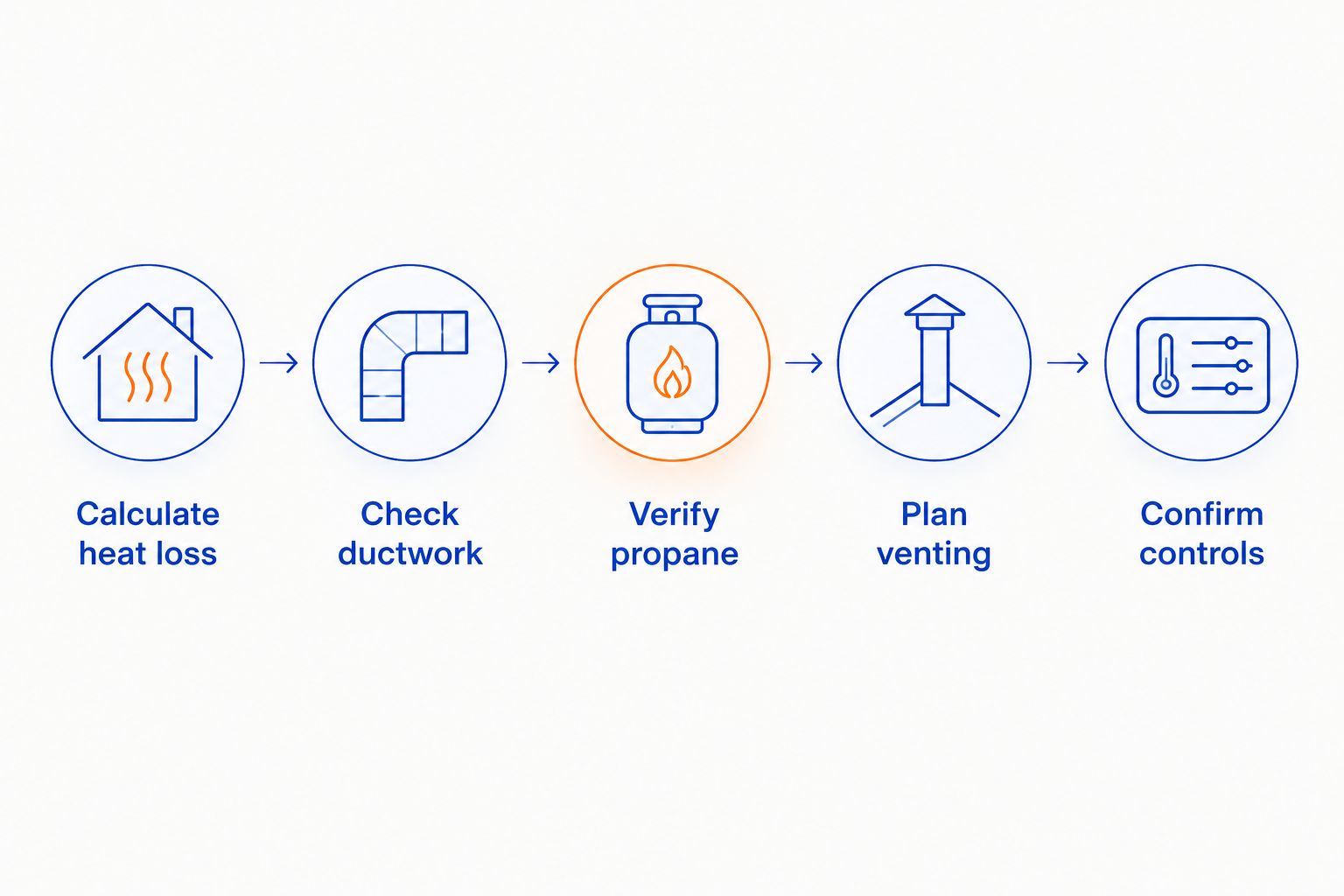
A sound furnace proposal connects the equipment to your home. Follow this sequence before authorizing a replacement:
- Calculate heat loss. Include insulation, windows, air leakage, and the home's dimensions. Do not simply copy the old furnace's capacity.
- Check ductwork. Confirm that supply and return ducts support the required airflow. Record rooms with persistent temperature differences.
- Verify propane. Have qualified professionals check the supply arrangement and the furnace's manufacturer-approved propane requirements.
- Plan venting. Identify approved intake and exhaust routes, clearances, and drainage provisions for the selected equipment.
- Confirm controls. Match the thermostat and control wiring to the intended furnace operation.
This sequence separates house problems from equipment choices. If airflow is restricted, moving from single-stage to modulating heat does not remove the restriction. If the vent route is unsuitable, a different efficiency label does not solve that either.
For an existing furnace, establish whether replacement is necessary before choosing a new configuration. A diagnosis can separate a repairable fault from a replacement decision. The guide to whether a furnace can be repaired instead of replaced covers that earlier step.
Rural installation details you should not overlook
Propane supply and conversion
Natural gas and propane require different fuel setup. Use only the manufacturer's approved propane configuration or conversion procedure for the exact furnace. Leave fuel-pressure adjustments and combustion checks to qualified professionals.
Ask who is responsible for checking the tank-side supply and who verifies furnace operation. Clear responsibilities prevent an equipment installer and propane supplier from leaving an unresolved issue between them.
Drainage and freeze exposure
Condensing furnaces need a managed condensate route. An exposed or unheated drainage route needs attention because freezing can interrupt drainage. The installation must follow the equipment instructions and applicable local requirements.
Have the contractor show where condensate goes. Do not accept an unexplained drain tube as a finished plan.
Electrical outages
A propane furnace still needs electricity for controls and air circulation. Propane in the tank does not keep a conventional forced-air furnace operating through a power outage.
If backup power matters, discuss the furnace's electrical requirements with qualified HVAC and electrical professionals. Keep portable generators outdoors and away from building openings, following their safety instructions.
Service after installation
For rural homeowners, identifying a service provider before installation is a practical part of the purchase. Ask who handles maintenance and faults for the proposed equipment.
West Heating & Cooling offers furnace service and 24/7 emergency service in its Lake of the Ozarks service area. Confirm the scope of your particular installation directly rather than assuming every listed feature or equipment configuration is included.
How the furnace configurations are ranked
This ranking prioritizes propane suitability, heating control, efficiency, installation fit, and serviceability. Two-stage condensing equipment is the default because it combines adjustable heat output with condensing operation without making modulation the starting requirement.
Modulating equipment earns the temperature-control slot. Single-stage condensing equipment earns the simpler-operation slot. Noncondensing equipment remains a conditional choice for documented installation constraints, not the default efficiency recommendation.
The ranking does not assign reliability scores or promise fuel savings. Neither a configuration label nor an AFUE rating establishes those results for your house.
Which propane furnace should you choose?
Start your 2026 comparison with a correctly sized two-stage condensing propane furnace. Compare modulating equipment if fine temperature control is the priority, and single-stage condensing equipment if straightforward burner operation matters more.
Before you approve anything, require a written proposal identifying the model, propane setup, sizing basis, duct changes, venting, drainage, controls, and startup checks. West Heating & Cooling provides furnace installation and maintenance locally; ask for the proposed installation details as well as the equipment name.
Plan your furnace replacement
Discuss furnace installation, repair, and maintenance in the Lake of the Ozarks service area.
FAQ
What's the best propane furnace for a rural Missouri home?
A correctly sized two-stage condensing propane furnace is the best starting point for balanced comfort and efficiency. Choose the exact model after checking propane approval, ducts, venting, drainage, and controls.
Is a modulating propane furnace better than a two-stage furnace?
A modulating propane furnace provides finer burner-output adjustment than a two-stage furnace. That makes it the stronger choice for precise temperature control, but it requires compatible controls and does not correct duct or insulation problems.
Can a natural-gas furnace run on propane?
A natural-gas furnace can run on propane only when the exact model supports a manufacturer-approved propane configuration or conversion. A qualified professional must complete the fuel setup and operating checks; not every furnace is convertible.
What does 95% AFUE mean for a propane furnace?
A 95% AFUE rating means approximately 95% of annual fuel energy becomes useful heat under the rating method. AFUE does not include duct losses or guarantee a particular reduction in your propane consumption.
Will a propane furnace work when the power goes out?
A conventional forced-air propane furnace needs electricity and does not operate normally during a power outage without suitable backup power. Its controls and blower depend on electrical power even when propane is present.
Can I keep my old furnace vent when replacing the equipment?
Keep an existing vent only when it meets the new furnace's requirements and passes inspection. Condensing and noncondensing furnaces have different exhaust requirements, so the old arrangement is not automatically suitable.
Who offers furnace service around Lake of the Ozarks?
West Heating & Cooling offers furnace installation, repair, maintenance, and 24/7 emergency service in the Lake of the Ozarks area. Its stated service areas include Camdenton, Osage Beach, Lake Ozark, Warsaw, and Lebanon.
One last thing
A higher-efficiency furnace does not repair a leaky house or undersized return duct. Before signing your 2026 replacement proposal, ask the contractor to explain why the selected heating capacity and airflow fit your home. A clear answer is more useful than another feature on the brochure.