Furnace installation time has no fixed duration: replacing a furnace in the same location is a different job from moving equipment or changing venting, electrical supply, gas connections or ductwork. The installer also needs time to check the completed system, so the time spent placing the furnace is not the same as the time until your heat is ready to use. For a 2026 installation, ask for a work window and a separate estimate of when heat will be restored.
- Furnace installation time has no fixed duration; the existing connections and required changes determine the work.
- A same-location replacement has fewer installation steps than a relocation or a new installation.
- West Heating & Cooling is a fit for Lake of the Ozarks customers who need a site-specific furnace installation plan.
- Ask when heat will be restored, not just when the new furnace will be set in place.
Why this matters
If you are arranging time at home for an installer, a vague promise about the job length is not enough. You need to know when the crew expects to arrive, whether the heat must be shut off, what work they expect to complete and what remains before the system can run. Those are separate questions, and the answers can change after the installer sees the existing setup.
For a furnace installation in 2026, start with the conditions at your property rather than a generic time estimate. Tell the contractor whether the furnace will stay in its current location, whether the system has known problems and whether other HVAC work is planned. West Heating & Cooling serves residential and commercial customers in the Lake of the Ozarks area and can discuss the work needed at your site.
How long does furnace installation take?
There is no reliable single-hour answer without seeing the job. A straightforward replacement and an installation that changes the surrounding system do not have the same scope. The table shows what to clarify before treating any proposed schedule as firm.
| Installation scenario | Work to clarify | Scheduling advantage | Main complication |
|---|---|---|---|
| Furnace replaced in the same location | Whether existing ductwork, venting and connections suit the new unit | The location and much of the surrounding setup are already established | Existing connections still need to be checked; a matching location does not guarantee a simple job |
| Furnace moved to another location | The new position and the changes needed to connect it | The new location can address a specific layout need | More surrounding work must be planned before heat can be restored |
| Furnace installed where there was no furnace | The heating layout, connections and any related system work | The setup can be planned for the space | There is no existing furnace arrangement to reuse |
| Furnace installed alongside other HVAC changes | Which work belongs to the furnace installation and which belongs to the wider project | The contractor can coordinate related work in one plan | The full project schedule is not the furnace-only work window |
Best for a simpler scope: A same-location replacement, provided the existing setup is suitable. Best for a layout change: A relocation, when keeping the furnace where it is does not meet the property's needs. Neither label is a time guarantee; both depend on the work confirmed at the site.
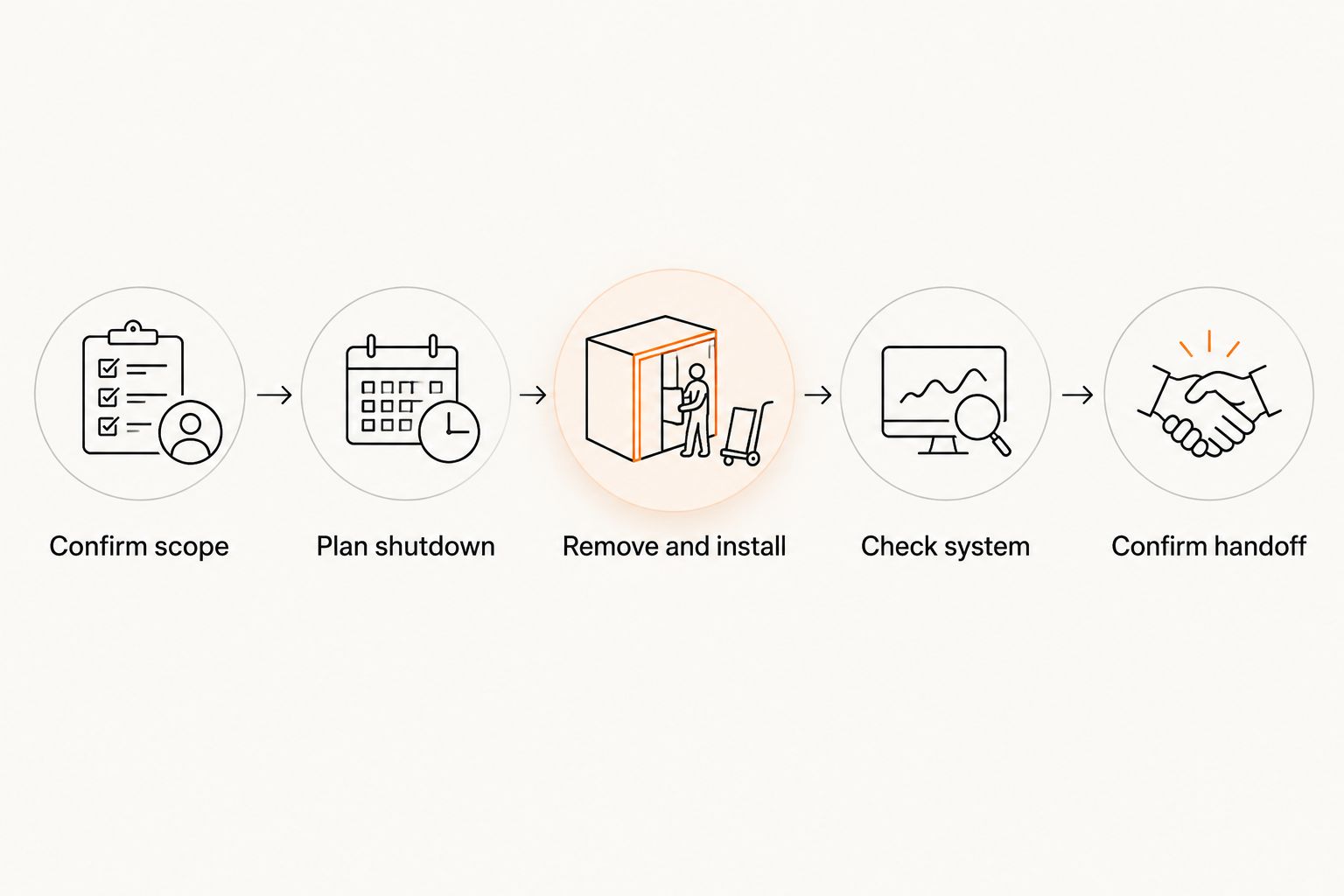
For a 2026 appointment, ask the contractor to describe the planned work in this order:
- Confirm the scope. Identify the furnace location and whether the job includes work on ductwork, venting or utility connections.
- Plan the shutdown. Ask when the existing heat must be turned off and what must happen before the new system can run.
- Remove and install. Clarify whether removal of the existing furnace is part of the work and where the replacement will sit.
- Check the system. Ask what checks the installer will complete before handing the furnace over for use.
- Confirm the handoff. Agree on how the installer will explain the controls and report any work that remains.
A contractor can give a more useful work window after these points are settled. If the scope is still unclear, treat the proposed duration as a planning question, not a promise.
Same-location replacement: what affects the work window?
Keeping the new furnace in the existing location removes the need to plan a different spot. It does not establish that the job will finish within a particular number of hours. The installer still needs to determine whether the existing ductwork, venting and connections suit the replacement, then check the system after installation.
Tell the contractor what you know about the current furnace before the 2026 visit. Has the heat stopped working, or is the replacement planned while the system still runs? Has another contractor identified a problem with the surrounding setup? These details help define what the appointment must cover; they do not replace an inspection.
If you need to be home for the work, ask for the arrival window and the expected heat-off period separately. An arrival time tells you when work starts. It does not tell you when testing ends or when the home will be warm again.
Relocation or new installation: why is the schedule less predictable?
Moving a furnace changes more than its position. The contractor must determine how the new location connects to the heating system and what must change around it. A new installation also lacks an existing furnace setup in that spot to assess for reuse. Do not plan a relocation using a same-location replacement estimate.
The same distinction matters for commercial properties. West Heating & Cooling offers furnace installation for residential and commercial customers, but a business should explain when the space is occupied and when heat is needed. The contractor can then discuss the proposed work window in the context of that property's use. There is no single commercial installation duration that follows from the building type alone.
In 2026, ask for a written description of what is included in the installation discussion: furnace placement, changes to connected equipment and the checks needed before operation. If related HVAC work is being discussed, ask whether its schedule is separate. That keeps a furnace work window from being mistaken for the timeline of the entire project.
Why furnace installation time varies
- Existing location: Keeping the furnace where it is avoids planning a new position; relocating it adds work to assess and connect the new location.
- Ductwork: The installer needs to check how the furnace connects to the existing air distribution system. Changes to that connection expand the scope.
- Venting: The venting arrangement must suit the installation. Work on that arrangement is distinct from setting the furnace in place.
- Utility connections: The required gas or electrical work depends on the equipment and the existing setup. Ask what the installation includes rather than assuming the connections can stay unchanged.
- Related HVAC work: If the visit also covers another part of the heating or cooling system, ask which tasks belong to the furnace job and which have their own timeline.
- Final checks: The installer must verify the system's operation before treating the installation as complete. Ask what remains between physical installation and restored heat.
These are questions for a site-specific estimate, not reasons to accept an open-ended schedule. Ask which factors apply to your property and which ones the contractor has already checked. If the proposed scope changes, request an updated work window before rearranging the rest of your day.
What should you ask before booking furnace installation?
Start with the question that affects your household or business most: When do you expect the heat to be off, and when do you expect it to be usable again? Then ask what could change that answer. A clear discussion separates the work the contractor can describe now from conditions that need an on-site look.
Use this short checklist for a 2026 booking:
- Will the new furnace remain in the current location?
- Have you reviewed the existing ductwork, venting and connections, or will that happen at the visit?
- Does the planned work include removing the old furnace?
- Is any other heating or cooling work part of the same appointment?
- What checks will you complete before the furnace is ready to use?
- How will you tell me if the scope or work window changes?
West Heating & Cooling is best for Lake of the Ozarks homeowners and businesses seeking a local contractor for furnace installation and a site-specific schedule. Its stated services include installation, repair and maintenance; the information here does not establish a fixed installation duration or guarantee that a particular appointment is available. Ask for the work window that applies to your property.
Discuss your furnace installation
Ask about the installation scope and when heat can be restored.
Will a furnace replacement leave you without heat?
Yes, expect a period without heat while the existing system is shut down for replacement. Ask for the expected shutdown and restoration points in the work plan; furnace installation time alone does not tell you how long the space will be without heat. If the old furnace has already failed, explain that when you contact the contractor.
West Heating & Cooling states that it offers 24/7 emergency service and repairs in the Lake of the Ozarks area. That is relevant if you need help with a heating failure, but it is not a promise that a new furnace can be installed during an emergency call. Make the distinction when describing what you need.
Can the installer give an exact finish time before seeing the furnace?
No exact finish time follows from the word replacement alone. The installer needs to understand the existing setup and the proposed furnace location before defining the work. You can still ask for a preliminary work window and for the point at which that window will be confirmed.
For a 2026 replacement, be specific about what you know and what you do not. If you have not checked the venting or connections, say so. A schedule based on confirmed site details is more useful than one based on an assumption that every existing component can remain as it is.
Is installation finished when the new furnace is connected?
No. The furnace also needs to be checked before you rely on it for heat. Ask the installer to explain what has been checked, how to use the controls and whether any related work remains. The handoff is part of the job you are scheduling, even though it happens after the furnace is positioned.
FAQ
How long does furnace installation take in 2026?
Furnace installation time has no fixed duration without a site-specific scope. Ask the installer for a work window after they assess the furnace location, connections and required checks.
Is replacing a furnace faster than moving one?
A same-location replacement has fewer location changes to plan than a relocation. Both still require the installer to assess the surrounding setup and check the completed system.
How long will my heat be off during furnace installation?
The heat-off period depends on the work needed at your property, not just the time spent placing the furnace. Ask when the existing system will be shut down and when the new one is expected to be ready to use.
Does furnace installation include removing the old furnace?
Ask the contractor to confirm whether removal is included in the proposed work. Do not use a work window until you know whether it covers removal, installation and final checks.
Can a furnace installation take longer if ductwork changes?
Yes. Changes to the furnace's connection with the ductwork add work beyond setting the unit in place. Ask the installer to identify any planned ductwork changes when discussing the schedule.
Can I schedule emergency furnace installation?
West Heating & Cooling states that it provides 24/7 emergency service and repairs, but that does not establish an emergency installation schedule. Explain whether you need immediate help with a failed furnace or a planned replacement.
What should I ask before taking time off for furnace installation?
Ask for the arrival window, expected heat-off period, planned scope and estimated time when the system will be ready to use. Confirm when the contractor will update you if the work changes.
One last thing
The most useful scheduling question is not simply how long the installer will be there. Ask when you can use the heat again. That answer accounts for the shutdown, the installation and the final checks—and gives you a clearer plan for a 2026 appointment.