
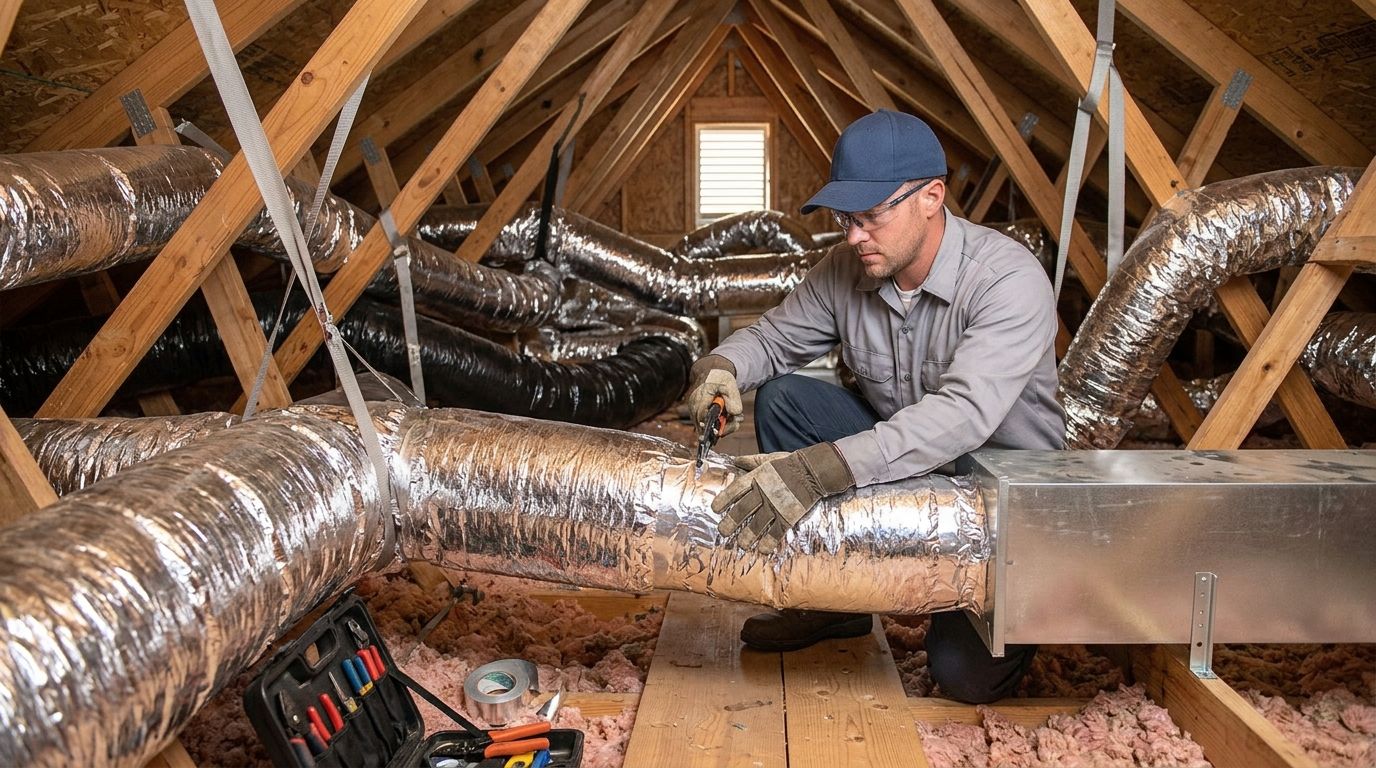
Ductwork installation cost isn't one number — it moves with the length of duct run, the material used, and how easy your attic, crawl space, or basement is to reach, and most phone quotes leave out removal of the old ductwork and final sealing. In 2026, homeowners across the Lake of the Ozarks area should expect a full walkthrough before any contractor puts a price on the job.
- Ductwork installation cost in 2026 depends on duct length, material, and how hard your attic or crawl space is to access, not a flat per-job rate.
- Flexible duct installs faster and bends around obstacles; rigid sheet metal duct holds up longer in exposed runs but takes more labor to fit.
- New construction ductwork installation costs less than retrofitting an existing home because there's no drywall, flooring, or insulation to cut into first.
- West Heating & Cooling measures the whole duct run on-site before quoting ductwork installation cost — skip any contractor who quotes over the phone.
Why this matters
Ductwork moves the air your furnace and AC unit produce. A strong furnace paired with a leaky, undersized duct run still delivers weak airflow to half the house, no matter how the equipment is rated. Lake of the Ozarks homes built before the 2000s in Camdenton, Osage Beach, and Lake Ozark often run duct systems sized for a smaller furnace, or routed through crawl spaces never meant for regular access.
Replacing or extending ductwork touches nearly every part of a heating and cooling upgrade, from a new furnace to a heat pump swap. Get the duct sizing wrong and even a high-efficiency unit can't perform the way its rating promises. A family-owned HVAC contractor like West Heating & Cooling walks the full duct run before quoting ductwork installation cost, because a number given without seeing the attic or crawl space isn't a real quote.
How much does ductwork installation cost?
Every ductwork installation cost breaks into three pieces: material, labor, and access difficulty. A short run of flexible duct in an open attic takes less labor than the same footage of rigid sheet metal cut and joined inside a finished basement ceiling. Sizing also matters — a contractor should run a load calculation against your furnace or AC unit's output, not guess at duct diameter.
Here's how the common duct materials compare on the factors that actually move the price:
| Duct Material | Install Speed | Durability | Best For |
|---|---|---|---|
| Flexible duct | Fast — bends around framing and obstacles | Shorter lifespan, prone to kinks and punctures | Attic runs, tight retrofit spaces |
| Sheet metal duct | Slower — cut and joined on site | Long lifespan, holds shape under static pressure | Exposed runs, commercial kitchens, high-static systems |
| Fiberglass duct board | Moderate — pre-insulated panels | Moderate lifespan, insulation can degrade over time | New construction, sound-sensitive rooms |
Sheet metal duct wins on durability for exposed or high-traffic mechanical rooms; flexible duct wins on cost and speed for attic retrofits. Fiberglass duct board sits in between and comes pre-insulated, which shaves a step off new construction jobs.
New construction vs. retrofit ductwork installation
New construction ductwork goes in while framing is still open, which is why it moves faster and touches nothing already finished. A retrofit means cutting into ceilings, walls, or floors to run new duct through a house that was never built with that path in mind — that's the labor difference that separates the two, more than the duct material itself.
Walkout basements, additions, and older lake homes with crawl space ductwork tend to run higher on the labor side of ductwork installation cost, because access alone can take longer than the actual duct fitting. If you're adding zoning to an existing duct system during a retrofit, plan for extra dampers and a zone control panel — that's added scope beyond the base ductwork installation, not part of it.
Signs you need new ductwork, not just a repair
A single crushed section or disconnected joint is a repair. A whole-house pattern of problems usually means the duct system itself is undersized or worn out:
- Uneven temperatures room-to-room that a thermostat adjustment doesn't fix
- Whistling, rattling, or banging sounds from registers when the furnace or AC unit runs
- Heavy dust buildup around vents even with a clean furnace filter
- Visible rodent damage, crushed sections, or disconnected runs in a crawl space or attic
- Ductwork original to a furnace that's already been replaced once
Any one of these points toward ductwork installation rather than another patch.
Why ductwork installation cost varies
- Total linear footage and vent count — more supply and return runs mean more material and more labor hours
- Material choice — flexible duct, sheet metal, and fiberglass duct board price out differently for the same run
- Access difficulty — a walkout basement ceiling, cramped crawl space, or finished attic all add time a slab-on-grade new build doesn't
- Removal and disposal of old ductwork — tearing out a failed system before installing the new one adds a labor step
- Sealing, insulation wrap, and airflow testing — unconditioned attic and crawl space runs need insulation the job spec should call out by name
- Permits and inspections — local building departments can require sign-off before the system is closed up
Get your ductwork measured
West Heating & Cooling walks the full run before quoting a number.
Is it cheaper to repair ductwork than replace it?
Repairing a section of ductwork is cheaper than replacing the whole run, but only when the damage is limited to a single leak, crushed section, or disconnected joint. Once ductwork is undersized, leaking at multiple seams, or original to a furnace that's already been swapped out once, patching becomes a short-term fix that costs more over years of lost airflow and repeat furnace repair calls.
How long does ductwork installation take?
Ductwork installation takes longer in a finished home than in new construction, because a retrofit means opening ceilings, walls, or floors to run new duct before closing everything back up. New construction ductwork goes in while framing is open, which is why it moves faster and disrupts nothing already built.
Do you need a permit for ductwork installation in Missouri?
Permit requirements for ductwork installation vary by county and city in Missouri, and Camdenton, Osage Beach, Lake Ozark, and Warsaw each set their own building codes. Confirm with the local building department or ask your HVAC contractor to pull the permit before work starts — skipping it can complicate a home sale inspection down the road.
FAQ
What's the average lifespan of residential ductwork?
Sheet metal ductwork typically outlasts flexible duct, which wears out faster from punctures and sagging insulation. Inspect ductwork any time you replace a furnace or AC unit, since old duct can undercut a new system's performance.
Is flexible duct or sheet metal duct better for a lake house?
Sheet metal duct holds up better in the humid crawl spaces common to lake house construction, while flexible duct works fine in a dry, conditioned attic. The right choice depends on where the run sits, not personal preference.
Can you install new ductwork without opening the ceiling?
Some retrofit ductwork installation runs through existing chases, closets, or soffits without cutting drywall, but tight layouts usually need at least partial ceiling or wall access. Ask your HVAC contractor to walk the planned route before assuming no cutting is needed.
Does ductwork installation cost more than duct sealing or repair?
Full ductwork installation costs more than sealing or repairing an existing run, since installation includes new material, full labor, and often removal of the old system. Sealing only makes sense when the existing duct is still structurally sound and properly sized.
What size ductwork does a furnace or AC unit need?
Duct size depends on the tonnage of the AC unit or the output of the furnace, not a fixed measurement that applies to every home. An HVAC contractor calculates duct size from a load calculation for the specific house.
Should ductwork installation happen before or after a new furnace install?
Ductwork installation should happen before or during a new furnace or AC unit install, never after, because the equipment is sized to match the duct system's airflow capacity. Installing ducts afterward risks a mismatch that leaves rooms too hot, too cold, or under-pressurized.
Does insulation wrap add to ductwork installation cost?
Insulation wrap adds labor and material to ductwork installation cost, but it cuts energy loss on runs through unconditioned attics, crawl spaces, or garages. Skipping insulation on those runs often means paying more in furnace and AC unit run time later.
One last thing
Most homeowners shopping ductwork installation cost focus on the visible parts — new registers, a quieter system, better airflow. The part that actually determines whether a new furnace or AC unit performs to its rating is duct sizing, and it's invisible once the drywall goes back up. A duct system sized for a smaller furnace still restricts airflow if you upgrade to a bigger unit without adjusting the ducts to match. Ask any contractor bidding a ductwork installation or replacement whether they're running a load calculation before quoting — if the answer is no, get a second quote before 2026 heating season hits.