Check your furnace filter every month and replace a standard disposable filter when it is dirty, or at least every 3 months, following ENERGY STAR guidance. For your 2026 maintenance schedule, treat that interval as a starting point: heavy use, pets, and dust can require earlier replacement, while specialty filters follow their manufacturer's instructions.
- How often change furnace filter? ENERGY STAR recommends monthly checks and replacement at least every 3 months.
- Replace a dirty disposable furnace filter early; the calendar does not measure dust buildup.
- Follow manufacturer instructions for deep-media and washable filters rather than assuming the same replacement schedule.
- Choose an HVAC-compatible filter; a higher MERV rating is not automatically the right choice.
Why this matters
A dirty furnace filter restricts airflow; waiting for a reminder does not make it safe to keep using. ENERGY STAR's heating and cooling maintenance guidance recommends checking filters monthly, especially during heavy-use seasons, and changing them when dirty.
Filter selection matters, too. If allergies drive your decision, start with the guide to furnace filters for allergies, then confirm that your furnace supports the filter you choose. Capturing more particles and maintaining enough airflow are separate requirements.
A filter change is routine upkeep, not a repair for every heating problem. If weak airflow or repeated shutdowns continue after you install the correct clean filter, the furnace needs diagnosis rather than another filter swap.
How often should furnace filters be changed?
For a standard disposable furnace filter, inspect every month and replace when dirty, with 3 months as the outer limit in ENERGY STAR's general guidance. The equipment manual and filter instructions take priority when they specify a different maintenance procedure.
Separate inspection from replacement. A monthly inspection lets you catch a loaded filter before the scheduled change date, while the manufacturer's instructions tell you whether the filter should be replaced or cleaned.
| Filter option | Best for | Maintenance approach | Advantage | Limitation |
|---|---|---|---|---|
| Disposable fiberglass filter | Systems whose instructions specify this filter type | Inspect monthly; replace rather than wash | Straightforward replacement | Generally captures fewer small particles than higher-efficiency pleated filters |
| Disposable pleated filter | Systems approved for the selected filter's resistance | Inspect monthly; replace when dirty and follow its instructions | Offers particle-capture options | A restrictive filter can reduce airflow in an unsuitable system |
| Deep-media filter | Systems with a matching media cabinet | Inspect regularly; follow the specified replacement interval | Provides more filter surface area | Requires the correct cabinet and replacement dimensions |
| Washable filter | Systems explicitly designed for a reusable filter | Clean and dry according to manufacturer instructions | Reusable rather than routinely discarded | Requires cleaning and drying; not interchangeable with every disposable filter |
These are filter categories, not interchangeable upgrades. Match the filter to your equipment before comparing its claimed service life.
For your 2026 reminder, write inspect monthly, not simply replace quarterly. A check catches problems a fixed replacement date misses.
Standard disposable filters: inspect every month
A standard disposable filter gives you a simple routine: check it monthly, replace it if dirty, and do not wash it for reuse. ENERGY STAR's general replacement guidance is at least every 3 months.
Look across the filter's surface, not just at one corner. Visible dust buildup, packed debris, or damaged material calls for replacement; however, appearance alone does not precisely measure airflow resistance.
If the filter appears clean but your furnace has weak airflow, do not assume the filter is responsible. Closed registers, equipment faults, and other airflow problems need a separate check.
Best for: homeowners whose furnace instructions specify a standard disposable filter. The advantage is straightforward upkeep; the limitation is that its condition can change faster than a calendar reminder suggests.
Deep-media filters: follow the cabinet's instructions
Deep-media filters use a larger filter surface than thin filters, but that does not establish one replacement interval for every model. Use the instructions for the installed filter and media cabinet.
Do not copy a neighbor's schedule. Differences in filter construction, household dust, and system use make that comparison unreliable.
Keep the exact replacement information with your 2026 maintenance notes. Record the dimensions, filter identifier when provided, and approved filtration rating so you do not substitute a similar-looking filter that fits poorly.
Best for: homes already equipped with a compatible media cabinet. The benefit is greater filter surface area; the limitation is that the cabinet requires a correctly matched replacement.
Washable filters: clean them, then let them dry
A washable filter follows a cleaning schedule rather than a routine discard-and-replace schedule. Confirm that the filter is labeled washable before applying water or cleaning products.
Follow its cleaning instructions and let it dry fully before reinstalling it. Replace a reusable filter if its frame or filtering material is damaged, according to the manufacturer's directions.
Never wash a disposable pleated or fiberglass filter to stretch its life. Washing can damage material that was not designed for cleaning.
Best for: equipment that explicitly accepts the reusable filter. Reuse is the advantage; cleaning, drying, and compatibility requirements are the trade-offs.
Why furnace filter replacement timing varies
A replacement schedule depends on how much material reaches the filter and how much air passes through it. Use these factors to decide whether a filter needs replacement before its usual deadline:
- System runtime: Longer heating or cooling operation moves more air through the filter. Check it during both seasons if the same system handles heating and AC.
- Pets: Pet hair and dander add material to the household air. Inspect the filter rather than assuming a pet-free household's schedule applies.
- Dust-producing work: Sanding, remodeling, and similar work create extra airborne debris. Check the filter after dusty work instead of waiting for the next reminder.
- Occupancy and activity: Changes in household use affect the material circulating through the system. A quiet property and a heavily used property need condition-based checks.
- Filter construction: Filter surface area and resistance affect how a filter performs as it loads. Thickness alone does not establish its replacement date.
- Fit and installation: Gaps or an incorrectly installed filter can let dust bypass the material. An unusually clean filter does not prove the installation is correct.
For a Lake of the Ozarks home used seasonally, check the filter when you return and resume regular HVAC use. An empty house does not guarantee a clean filter, especially if the heating or cooling system kept running.
How to check and change your furnace filter
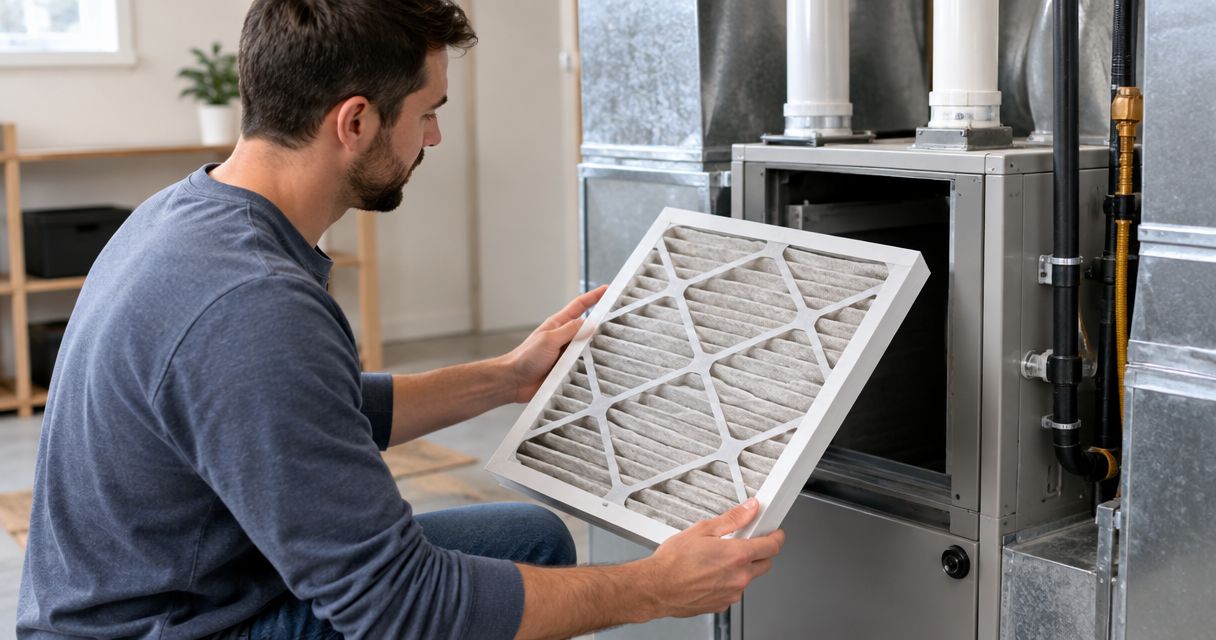
Use the furnace manual before opening any access panel. The filter can sit in a return-air grille, a dedicated cabinet, or a slot near the furnace; you do not need to dismantle equipment to search for it.
- Turn off. Stop the system at the thermostat and follow the manual's shutdown instructions before accessing the filter. Do not reach into running equipment.
- Find filter. Locate the designated filter compartment. If its position or access method is unclear, stop and ask a technician.
- Match size. Read the existing filter's dimensions, then confirm them against the equipment or cabinet instructions. Do not force a filter into a slot or fill gaps with improvised material.
- Check condition. Examine the filter for accumulated debris and damage. Replace a dirty disposable filter; clean a washable filter only as directed.
- Follow arrow. Install the correct filter with its airflow arrow pointing in the direction specified by the equipment. In a typical furnace return installation, that points toward the blower.
- Close access. Secure the cover or grille, restore operation as instructed, and record the date. Keep the next inspection reminder separate from the expected replacement date.
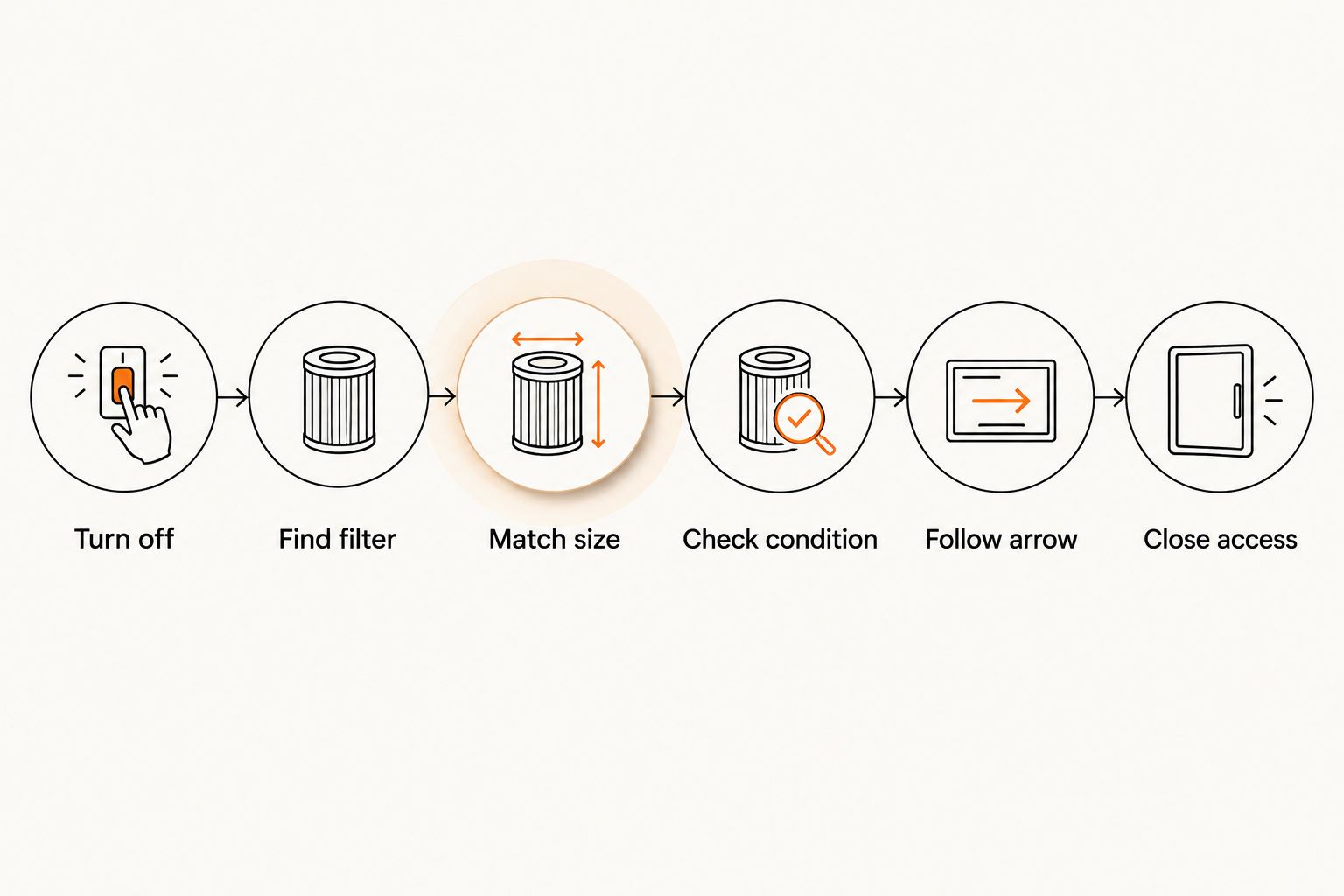
If the new filter bends, leaves a gap, or prevents the access cover from closing, stop. A filter that almost fits is not the correct replacement.
Should I change my furnace filter more often if I have pets?
Check every month even with pets, and replace a dirty disposable filter before the 3-month mark. Pet hair and dander add to the filter's load, but they do not establish a universal replacement interval for every home.
Use what you find during inspection to adjust your routine. If the filter repeatedly becomes dirty before the planned replacement date, bring that date forward instead of leaving a loaded filter installed.
Does a higher MERV rating mean I can wait longer?
No: the monthly inspection rule still applies, and a higher MERV rating does not set a longer replacement interval. MERV describes particle-capture performance, not how long a filter will remain usable in your home.
The U.S. Environmental Protection Agency's residential air-cleaner guidance advises choosing a filter your system can accommodate. Check equipment compatibility before increasing filtration; do not assume the highest rating on the shelf is the right fit.
Should I change the furnace filter during AC season?
Check every month during AC use if your central cooling system uses the furnace's blower and filter. That filter handles air movement in summer as well as winter, so a heating-only reminder misses part of its workload.
For your 2026 maintenance calendar, tie inspections to HVAC operation rather than the word furnace. Confirm the filter location for each system if your property has separate heating and cooling equipment.
When a filter change is not enough
A clean, correctly installed filter removes one possible cause of restricted airflow. It does not rule out other faults.
Arrange service if the furnace repeatedly stops before reaching the thermostat setting, airflow remains weak, or you cannot confirm the approved filter. Do not remove the filter and run the system as a workaround.
West Heating & Cooling is best for Lake of the Ozarks homeowners who need local furnace maintenance or repair. The family-owned contractor serves Camdenton, Osage Beach, Lake Ozark, Warsaw, and Lebanon, with residential and commercial HVAC installation, repair, and maintenance.
You can contact West Heating & Cooling when filter selection or persistent operating problems require help. The company also offers 24/7 emergency service, but ordinary filter replacement is routine upkeep—not automatically an emergency service visit.
Get help with furnace maintenance
Ask about filter compatibility or furnace problems that continue after a filter change.
FAQ
How often should I change my furnace filter in 2026?
Inspect your furnace filter every month and replace a standard disposable filter when dirty, or at least every 3 months under ENERGY STAR's general guidance. Follow manufacturer instructions for specialty filters and equipment-specific requirements.
Can I leave the same furnace filter in all year?
Do not leave a standard disposable furnace filter installed all year without inspection and replacement. ENERGY STAR recommends monthly checks and replacement at least every 3 months; specialty filters follow their own instructions.
How do I know whether my furnace filter is dirty?
Check the filter for accumulated dust, packed debris, and damaged material. Appearance is useful, but it does not precisely measure airflow resistance, so keep following the equipment's maintenance instructions.
Can I wash a disposable furnace filter?
No, do not wash a disposable furnace filter for reuse. Clean only a filter explicitly labeled washable, and let it dry fully before reinstalling it according to its instructions.
Does a thicker furnace filter always last longer?
No, thickness alone does not establish a furnace filter's replacement interval. Follow the filter and cabinet instructions, and inspect regularly for loading or damage.
Should I use the highest MERV rating I can find?
No, choose a MERV rating your HVAC system can accommodate. A filter that restricts airflow is not an appropriate upgrade just because it captures smaller particles.
Can West Heating & Cooling help if a new filter does not fix weak airflow?
West Heating & Cooling offers furnace maintenance and repair for residential and commercial customers in the Lake of the Ozarks area. Persistent weak airflow after a correct filter change needs diagnosis rather than repeated filter replacement.
One last thing
A filter that stays unusually clean deserves a fit check, not congratulations. Air can bypass filtering material when the filter is missing, incorrectly seated, or surrounded by gaps.
For your 2026 routine, photograph the correct filter label and installation direction once you confirm them. That gives you a reference at the next change—and useful information for West Heating & Cooling if you need furnace service.