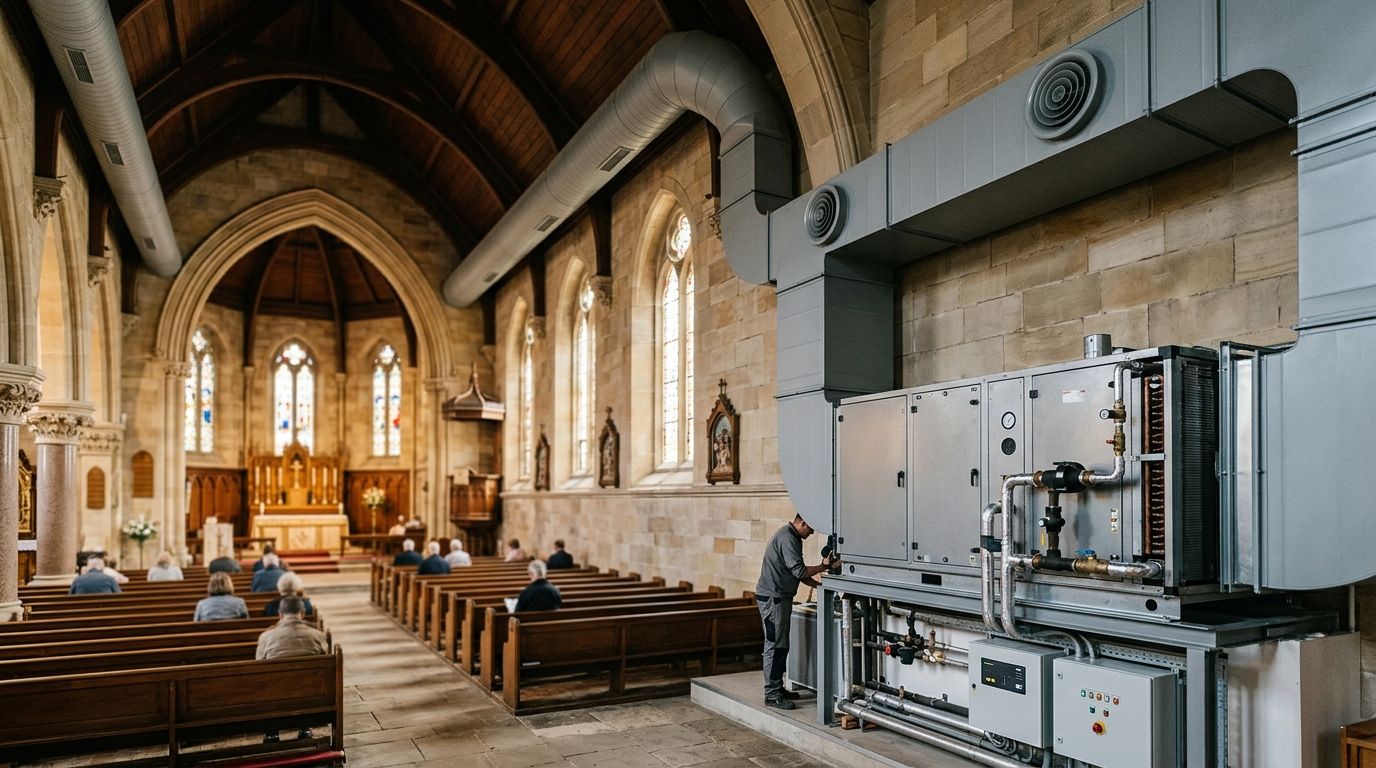
HVAC for churches means sizing, zoning, and scheduling equipment around a room that sits empty six days a week and packs to capacity on the seventh — the goal is comfortable worship and event space without paying to condition an empty sanctuary all week. A 300-seat sanctuary has cooling and ventilation needs that look nothing like a 300-seat office floor, because the load swings from near-zero to maximum in under an hour and back again.
- Standard residential-style load calculations undersize HVAC for churches because occupancy swings from empty to full in under an hour.
- Zoned systems that separate sanctuary, fellowship hall, and offices cut run time on rooms that sit empty most of the week.
- Dehumidification matters as much as cooling capacity for rooms packed with 200+ people for two hours at a stretch.
- Maintenance built around your event calendar — not a generic quarterly schedule — prevents mid-service equipment failure.
- West Heating & Cooling services churches and event venues across Camdenton, Osage Beach, Lake Ozark, Warsaw, and Lebanon.
Why HVAC matters for churches and event venues
A sanctuary or event hall isn't occupied evenly across the week. Sunday morning might bring 250 people into a room that sat empty Monday through Saturday, and a Wednesday night youth event might use one wing while the rest of the building sits dark. Equipment sized and zoned for a steady 9-to-5 office load either runs constantly to catch up before service starts, or overshoots and leaves the building cold and clammy for six days.
Humidity is the bigger problem most churches don't plan for. Two hundred bodies in pews for a two-hour service generate enough moisture load to fog windows and leave carpets and hymnals damp, even when the thermostat reads a comfortable 72 degrees. Standard air conditioner sizing calculations built around steady residential occupancy don't account for that spike, which is why a system that looks correctly sized on paper still leaves a sanctuary muggy in 2026's humid Missouri summers.
Event venues face a related version of the same problem: banquet halls, reception spaces, and multi-purpose rooms need to swing from empty to full capacity on short notice, often with no lead time to pre-cool or pre-heat the space.
Calculate your sanctuary's real occupancy load
A proper load calculation for assembly space starts with peak occupancy, not average occupancy — the ACCA Manual J method used by licensed contractors accounts for people, lighting, and equipment loads separately, which matters more in a sanctuary than in a house.
- Count peak seating capacity, not average Sunday attendance
- Add heat load from stage lighting, sound equipment, and video screens if the sanctuary uses them
- Separate the sanctuary calculation from fellowship hall, nursery, and office calculations — they don't share a load profile
- Factor in high ceilings and open volume, which change how conditioned air stratifies in a room
- Get a written load calculation from your contractor before buying equipment sized by square footage alone
Zone the building for intermittent use
Most churches operate through one central system that treats the sanctuary, offices, and fellowship hall as a single zone. That means the whole building runs on the sanctuary's schedule, or the offices sit cold on weekdays so the sanctuary is ready by Sunday.
- Split sanctuary, offices, nursery, and fellowship hall into separate zones with independent thermostats
- Set office and nursery zones to normal weekday schedules instead of matching the sanctuary's Sunday-only demand
- Program the sanctuary zone to pre-condition on a schedule tied to service times, not a flat setpoint
- Review zoned HVAC systems built for multi-story and multi-zone buildings if the current setup runs one thermostat for the whole building
- A licensed contractor can retrofit zoning dampers onto most existing ductwork without a full system replacement
Choose equipment sized for irregular schedules, not steady occupancy
Equipment picked for a church needs to ramp from idle to full capacity fast, then idle again for days. Undersized equipment never catches up before service starts; oversized equipment short-cycles and wears out early without ever running long enough to dehumidify properly.
- Ask for variable-speed or two-stage equipment instead of single-stage units, which only run at one output level
- Confirm the contractor sized equipment off the peak-occupancy load calculation, not the empty-building square footage
- Compare commercial HVAC systems built for small businesses against residential-grade equipment scaled up — they're built for different duty cycles
- Check the manufacturer's rated cycles per hour against how often the sanctuary actually starts and stops during a typical week
- For buildings that also run a commercial kitchen for fellowship meals, the restaurant and commercial kitchen HVAC guide covers make-up air requirements that apply the same way
Add dehumidification and ventilation for packed events
Cooling capacity alone doesn't solve a room full of people. Ventilation standards for places of assembly (covered under ASHRAE 62.1) call for outdoor air rates scaled to occupancy, not square footage, which is why churches often need dedicated ventilation equipment separate from the main heating and cooling system.
- Install a standalone dehumidifier or a dehumidification-capable air handler for the sanctuary zone
- Verify outdoor air ventilation rates against occupancy, not floor area, especially for basement fellowship halls
- Run exhaust fans in nurseries and bathrooms on a separate schedule from the main system
- Check filtration (MERV 8 or higher) if the congregation includes members with respiratory sensitivities
- Address humidity before it becomes a mold problem in choir rooms, storage closets, and basements
Set a maintenance schedule around your event calendar
A generic spring-and-fall maintenance visit misses the point for a building whose heaviest use days are fixed and predictable. Churches know exactly when Christmas Eve, Easter, and Vacation Bible School fall — maintenance should happen before those dates, not after.
- Schedule a full system check two to three weeks before Christmas Eve and Easter services, your highest-occupancy events
- Change filters more often in sanctuary zones that see heavy seasonal traffic
- Compare maintenance plan options built around fixed visit schedules against ones that flex around a facility calendar
- Log every service call so a facilities volunteer or staff member has a maintenance history when equipment starts acting up
- Build a relationship with one contractor rather than calling around each time — repeat visits catch problems faster because the technician already knows the system
Build redundancy for weddings, funerals, and holiday services
A breakdown on a Tuesday afternoon is an inconvenience. A breakdown two hours before a wedding or a packed Christmas Eve service is a crisis with no backup plan. Facilities that host weddings, funerals, and community events on short notice need a faster response option than a standard service call queue.
- Confirm your contractor offers 24/7 emergency service, not just business-hours scheduling
- Ask whether commercial accounts get priority dispatch over standard residential calls
- Keep a spare portable unit or space heater on-site for a bridge solution during a repair window
- Review HVAC service contract options built for multi-property and facility management if your church manages more than one building or campus
Budget for worship space and multi-use event space differently
A sanctuary used once or twice a week has a different cost profile than a fellowship hall or event space rented out for weddings, reunions, and community meetings several times a month. Treating them as one line item in the budget hides where the real operating cost sits.
- Track run hours separately by zone if your system supports zone-level reporting
- Budget higher-frequency maintenance for the fellowship hall or event space if it sees more bookings than the sanctuary
- Factor equipment lifespan differently — a unit running short, frequent cycles wears differently than one running long, steady cycles
Comparing HVAC approaches for churches and event venues
| Approach | Best for | Key limitation |
|---|---|---|
| Single central system, no zoning | Small chapels under roughly 100 seats with one main room | Whole building runs on the sanctuary's schedule; offices and nursery run cold or wasteful |
| Zoned system with sanctuary/office/hall separation | Multi-room churches with offices, nursery, and fellowship hall | Higher upfront installation cost for dampers and additional thermostats |
| Variable-speed commercial-grade equipment | Sanctuaries with sharp occupancy swings and holiday peak crowds | Requires a contractor experienced with commercial-duty equipment, not residential-only technicians |
| Standalone dehumidification add-on | Any sanctuary with wood pews, carpet, or a basement fellowship hall | Adds a second piece of equipment to maintain and budget for |
Get a church HVAC assessment
West Heating & Cooling serves churches and event venues across the Lake of the Ozarks area.
Common mistakes churches make with HVAC
- Sizing off empty-building square footage. A load calculation based on the sanctuary's floor area, without factoring peak occupancy, almost always undersizes the equipment for a full house.
- Running the whole building on one thermostat. Offices and nursery spaces end up conditioned on the sanctuary's Sunday-only schedule, wasting energy the other six days.
- Treating dehumidification as optional. A muggy sanctuary during a packed summer service is a humidity problem, not a cooling capacity problem, and it needs a different fix.
- Scheduling maintenance by calendar season instead of event calendar. Skipping a pre-Christmas or pre-Easter check means the highest-attendance days are the least-inspected.
- Waiting for a breakdown to find a contractor. Facilities that host weddings and funerals on short notice need an existing relationship with a 24/7 emergency service provider before the crisis, not during it.
FAQ
What size HVAC system does a church sanctuary need?
Sanctuary sizing depends on peak seating capacity, ceiling height, and lighting or AV heat load, not just square footage. A licensed contractor should run an ACCA Manual J load calculation based on full occupancy before recommending equipment.
Is zoned HVAC worth it for churches?
Yes for any church with separate offices, nursery, or fellowship hall space, because zoning lets each area run on its own schedule instead of following the sanctuary's Sunday-only demand. Small single-room chapels see less benefit from zoning.
How often should a church get HVAC maintenance?
Maintenance should happen at least twice a year, timed two to three weeks before your highest-attendance events like Christmas Eve and Easter rather than on a generic spring-and-fall schedule. Filters in sanctuary zones need more frequent changes during heavy-traffic seasons.
Why does my church sanctuary feel humid even when the AC is running?
Standard air conditioning sized for average occupancy often can't remove enough moisture during a packed service with 200 or more people in the room for two hours. Dedicated dehumidification equipment, separate from the main cooling system, solves this.
Do event venues need commercial-grade HVAC equipment?
Event venues with sharp swings between empty and full capacity benefit from variable-speed or two-stage commercial equipment built for frequent start-stop cycles, since single-stage residential-grade units short-cycle under that pattern. This matters most for venues booking multiple events per week.
What happens if HVAC fails right before a wedding or funeral?
A 24/7 emergency service contract with a local contractor is the difference between a fast repair and a scrambled last-minute fix. Facilities that host time-sensitive events should confirm emergency response availability before it becomes urgent, not after.
Can one HVAC system serve both the sanctuary and a fellowship hall used for rentals?
One system can serve both spaces if it's properly zoned, but the two areas usually have different usage patterns and should be tracked and budgeted separately. A fellowship hall booked for weddings and community events several times a month wears differently than a sanctuary used once a week.
How much ventilation does a packed sanctuary need?
ASHRAE 62.1 sets outdoor air ventilation rates for assembly occupancy based on headcount, not floor area, which is why sanctuaries often need dedicated ventilation equipment beyond the main heating and cooling system. A contractor familiar with commercial ventilation codes should verify the rate for your building.
One last thing
The detail most churches miss entirely: your highest HVAC demand day of the year is probably not the hottest or coldest day of 2026 — it's Christmas Eve or Easter, when peak occupancy and peak outdoor temperature swing don't line up with a typical maintenance calendar. Schedule your pre-service equipment check around your attendance calendar, not the weather forecast.