
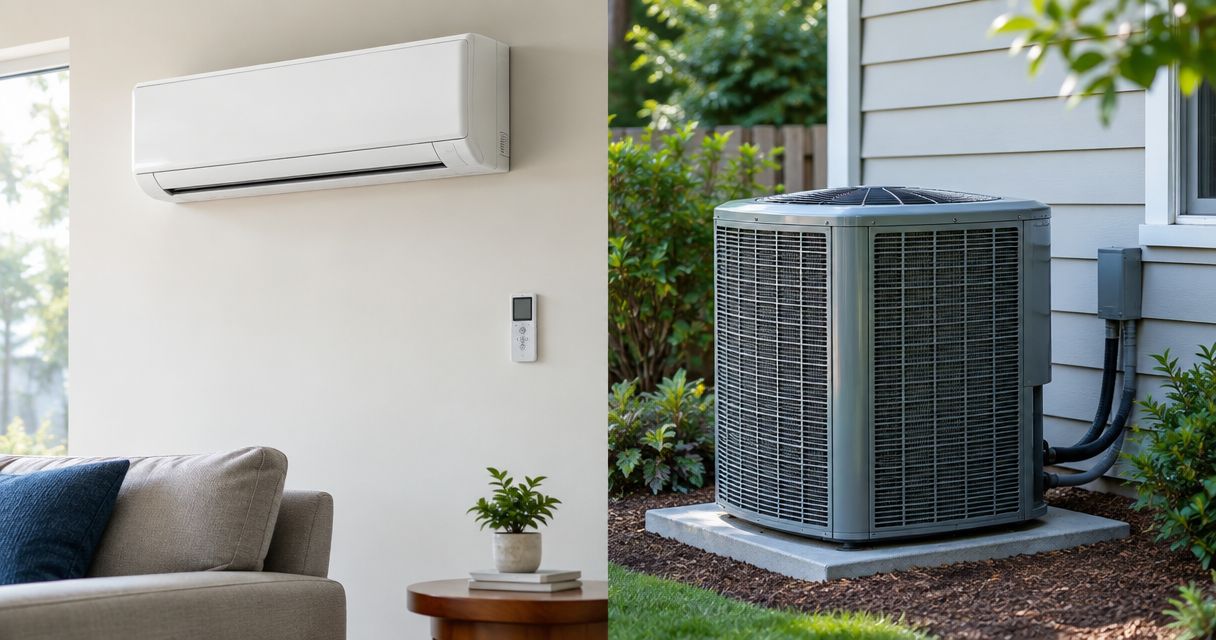
A ductless mini split can be cheaper than central air when you need to cool one room or a small part of a home, especially if installing central air would also require new ductwork. Central air can be the cheaper choice for whole-home cooling when usable ducts are already in place. For a fair mini split vs central air cost comparison in 2026, include installation work and the space each quote will cool—not just the equipment.
- Mini split vs central air cost: ductless is often the better fit for one room; central air can cost less for a ducted whole home.
- New ductwork can change the result of a central air quote in 2026.
- West Heating & Cooling is best for Lake of the Ozarks customers who need an on-site HVAC installation quote.
- Compare the rooms covered, installation work and heating needs before choosing either system.
Why this matters
A quote for one mini split serving one room is not comparable to a central air quote serving an entire house. Both figures can be accurate while answering different questions. Start by deciding which spaces need cooling, then ask each contractor to quote a system for the same job. If ductless is on your shortlist, the guide to mini split installation cost covers that option in more detail.
In the Lake of the Ozarks area, this decision also affects how you use the home. A room that gets uncomfortable while the rest of the house stays cool calls for a different solution than a house without working air conditioning. The cheapest quote is not the better deal if it leaves rooms you intended to cool outside the plan. That applies whether the space is a primary residence, a lake house or part of a commercial property.
Is a ductless mini split cheaper than central air?
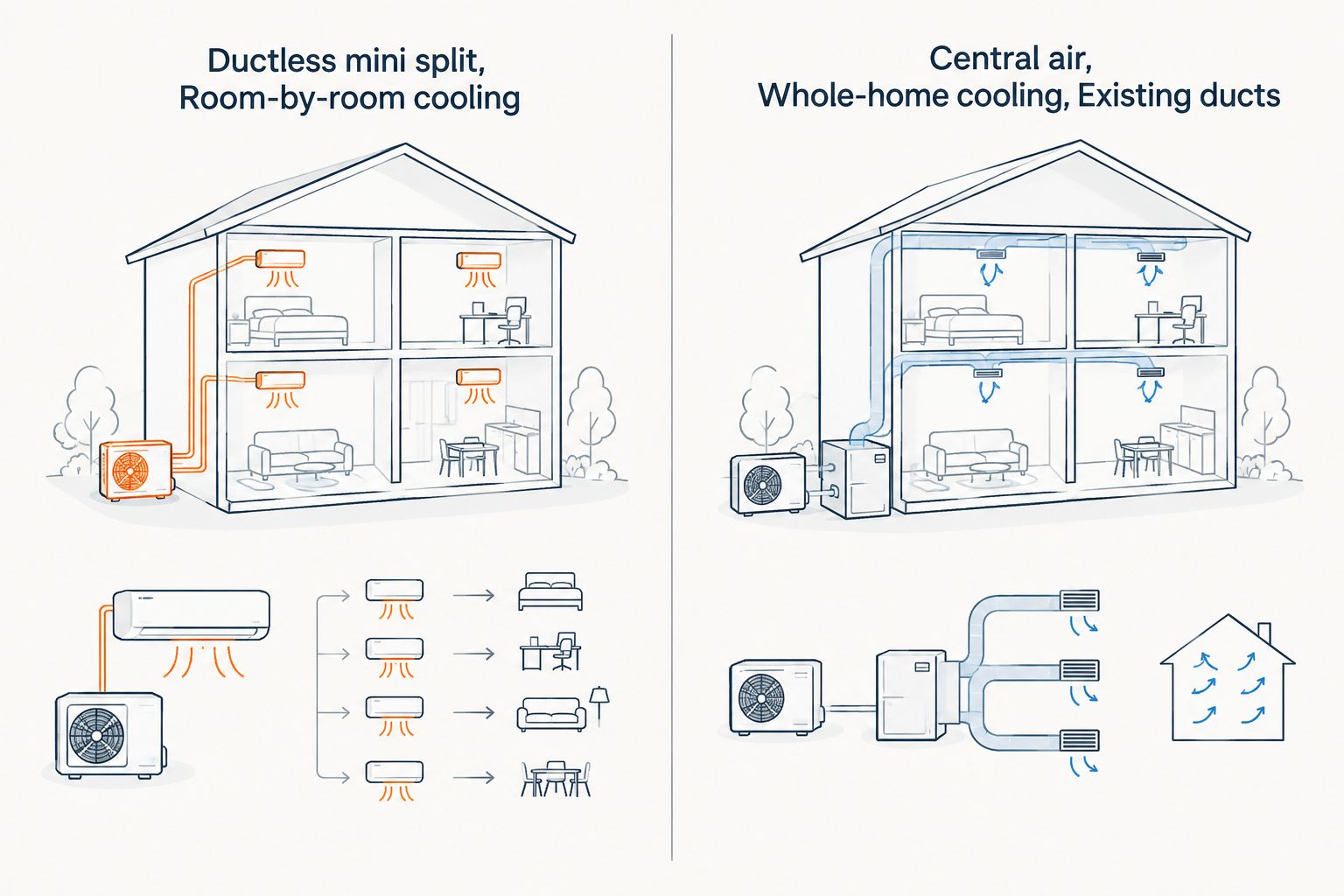
Yes for some single-room projects; not necessarily for a whole home. A mini split does not need supply and return ducts to serve a room. Central air uses ductwork to move cooled air through the building, so the condition and availability of those ducts matter to installation cost. In 2026, the deciding question is whether you are adding cooling to a limited area or replacing a system that already serves the whole property.
| Option | Best for | Cost consideration | Advantage | Drawback |
|---|---|---|---|---|
| Ductless mini split | Room-by-room cooling where ducts are absent or unsuitable | Installation does not depend on adding distribution ducts for each indoor unit | Lets you target the spaces you plan to cool | Serving more rooms requires a design that accounts for each space |
| Central air | Whole-home cooling with existing ducts in usable condition | Duct repairs or new ductwork add to the installation scope | Uses ducts to distribute cooling across connected rooms | A problem with the ducts can remain a problem after equipment replacement |
The table describes different scopes, not a price ranking that holds for every house. Ask for written quotes that identify the rooms served, equipment location, electrical work, duct work and any other installation tasks. Without that scope, a lower figure tells you little about what you will actually get.
A central air quote deserves particular scrutiny when a contractor has not inspected the ducts. Existing ducts do not automatically mean usable ducts; their layout and condition still need to suit the proposed system. A ductless quote needs the same scrutiny on room coverage. A single indoor unit is not a substitute for a whole-home plan simply because it is cheaper to install than a whole-home system.
One-room cooling: ductless often has the cost advantage
If you want to cool 1 room that existing ducts do not reach, a ductless mini split avoids making that room part of a ducted system. That is its clearest cost case. You still need a quote for the complete installation, including where the indoor and outdoor equipment will go and whether the electrical setup needs work.
Best for: a defined space that needs its own cooling solution. The benefit is that the work can focus on that space. The limitation is just as important: a quote for one room should not be treated as a quote to cool adjoining rooms. Ask the contractor to name every room the proposed system is intended to serve.
If your current central air already cools most of the house, explain what is wrong with the problem room before agreeing to new equipment. The cause might lie in how air reaches that room rather than in the cooling equipment itself. Comparing those possibilities is part of deciding whether an addition, a duct change or a different system addresses the actual problem.
Whole-home cooling: existing ducts can favor central air
When usable ducts already serve the rooms you need to cool, central air can be the more direct replacement. The distribution system is already there, subject to inspection, so the project differs from installing central air in a building with no ducts. That difference can outweigh the appeal of a lower quote for a ductless setup covering fewer rooms.
Best for: a home whose existing ducts can serve the intended cooling area. Central air's advantage is broad coverage through those ducts. Its drawback is dependence on them: if ducts need repair or changes, those tasks belong in the cost comparison. Ask whether the quote includes duct assessment and whether any recommended duct work appears as a separate line item.
A whole-home ductless design is also possible, but its cost case is different from a one-room installation. The contractor must account for each area you expect to cool and specify how the proposed equipment will serve it. Do not compare that design with a central air quote until both cover the same rooms and both identify work outside the equipment itself.
Why mini split vs central air cost varies
The cost difference comes from the job each system must do and the work already completed in the building. For a 2026 comparison, ask the contractor to address these factors in writing:
- Rooms covered. A quote for 1 room and a quote for 2 rooms have different scopes. List the spaces you expect to keep comfortable before requesting either system.
- Existing ducts. Central air relies on ducts to distribute cooling. Whether those ducts exist, reach the right rooms and can be used affects the work required.
- New ductwork. Adding ducts is part of the project cost when a building has none and you choose a ducted system. Do not leave it out of the central air side of the comparison.
- Equipment placement. The location of indoor and outdoor equipment affects the installation plan for either option. Have the contractor explain the proposed locations rather than comparing equipment alone.
- Electrical work. Ask what the existing electrical setup can support and which changes, if any, appear in each quote. Do not assume the equipment price covers that work.
- Heating needs. If you also need a heating solution, say so before comparing cooling quotes. An air-conditioning-only proposal and a proposal that includes heating do not cover the same need.
These factors work together. A house with ducts can still need duct work; a room without ducts can still need electrical work. Neither system is automatically cheaper once all installation tasks are counted. The useful comparison is the cost of meeting the same comfort goal, not the cost of buying different pieces of equipment.
The choice becomes clearer when you separate scope from system type. For example, a quote to cool a single added room answers a narrow question. A quote to cool every occupied room answers a broader one. If both appear on the same page without a room list, ask for that list before comparing them.
How to compare installation quotes
Give each contractor the same description of the property and the same list of rooms. Say whether you want cooling only or need the proposal to address heating too. In 2026, a quote that omits your intended coverage cannot answer whether ductless or central air costs less for your project.
Then check each proposal for the work that surrounds the equipment. Does the central air proposal address duct condition and any duct changes? Does the mini split proposal identify the areas each indoor unit is intended to serve? Do both account for equipment placement and electrical work? Request clarification where a line item is unclear rather than assuming the task is included.
West Heating & Cooling is best for Lake of the Ozarks customers who need an on-site HVAC installation quote. West Heating & Cooling offers AC installation for residential and commercial customers in the area. Its role in this comparison is to assess your space and quote the work required; the service itself is not evidence that either equipment type is cheaper at your property.
Use the same standard when comparing proposals from any HVAC contractor. A clear scope tells you what you are paying to cool and what remains outside the job. If one proposal includes duct work and the other does not, request an explanation before treating the totals as competing answers to the same question.
Get an HVAC installation quote
Discuss the rooms you need to cool and the installation work your property requires.
Will a mini split cost less to run?
A lower installation quote does not establish a lower electricity bill. Operating cost depends on the system selected, how it is used and which spaces you cool. If you plan to cool one room rather than the whole home, say that when requesting a comparison; if you plan to cool the entire home, ask each contractor to evaluate that same use.
In 2026, request the proposed equipment details rather than accepting a general claim that ductless or central air always costs less to run. The installation decision and the operating-cost decision are related, but they are not interchangeable. A proposal should make clear what equipment it includes before you compare its expected energy use with another proposal.
Does new ductwork make central air more expensive?
New ductwork adds work to a central air installation. That can make ductless the more attractive option when you need to cool a limited area and no usable ducts reach it. It does not prove ductless will cost less for every whole-home project; that answer requires quotes for the same rooms and the actual work each design needs.
Ask whether a central air quote includes installing ducts, changing existing ducts or neither. Those are different scopes. If the proposed duct route affects rooms you use every day, have the contractor explain where the work will take place before choosing on cost alone.
Should I replace central air with a mini split?
Replace central air with ductless only if the ductless plan covers the rooms you need and addresses the reason for changing systems. A problem in one room does not, by itself, mean a whole-home system needs replacement. Likewise, replacing cooling equipment without examining problem ducts can leave the underlying issue untouched.
Ask for separate explanations of the existing system's condition, the ducts and the proposed coverage. If repair is under consideration, compare the repair scope with both replacement designs. A 2026 decision should start with the problem you want fixed, not an assumption that one system type always wins.
FAQ
Is a ductless mini split cheaper than central air in 2026?
A ductless mini split can be cheaper for one room, while central air can be cheaper for whole-home cooling when usable ducts already exist. Compare quotes that cover the same spaces and include all installation work.
What's cheaper for a house without ductwork?
Ductless can avoid the work of installing distribution ducts, making it a strong option to quote for a house without them. Compare a ductless design covering every intended room with a central air quote that includes new ducts.
What's cheaper if I already have central air ducts?
Central air can have the cost advantage when existing ducts serve the rooms you need and are suitable for the proposed system. Have a contractor inspect the ducts before treating them as ready to reuse.
Can one mini split cool my whole house?
Do not assume one indoor unit will cover your whole house. Ask the contractor to identify the rooms the proposed equipment is designed to serve.
Does a mini split provide heating as well as cooling?
A ductless heat pump can provide both heating and cooling. Tell the contractor if you need both so the proposal addresses the same job as any central system quote.
Should duct repairs be included in a central air quote?
Any duct repairs the contractor recommends should be identified in the proposed scope. Check whether they are included in the quoted work or listed separately before comparing totals.
How do I get a fair mini split vs central air cost comparison?
Ask for written proposals covering the same rooms and the same heating or cooling needs. Check each proposal for duct work, equipment placement and electrical work.
One last thing
The question to ask first is not which system costs less. It is which rooms the quoted system will serve. That single detail exposes the most misleading comparison: a ductless quote for part of a building set against a central air quote for all of it. In 2026, have West Heating & Cooling identify the coverage and installation work in the proposal before you judge the result. A clear scope also gives you a better basis for comparing another contractor's quote.