Repair is usually the cheaper immediate choice when an AC unit has a clearly identified fault and the rest of the system is sound. Replacement is the better choice when a diagnosis finds widespread damage, repeated failures or a system that cannot reliably cool the space. In 2026, compare a written repair scope with a written replacement scope before choosing; the cheaper immediate fix is not always the cheaper long-term decision.
- Repair or replace AC unit? Repair a confirmed, isolated fault; replace a system with widespread damage or recurring failures.
- Get written repair and replacement scopes before deciding. Neither option has a universal cost advantage over time.
- West Heating & Cooling is best for Lake of the Ozarks customers who need an AC diagnosis and a clear next step.
Why this matters
A warm house does not tell you whether the AC needs replacement. The same complaint can start with a thermostat setting, restricted airflow or a fault inside the equipment. Approving a new system before identifying the cause risks paying for work that does not address the original problem.
The reverse mistake also costs you: approving another repair without asking why the unit keeps failing. If you are in the Lake of the Ozarks area, West Heating & Cooling offers AC repair and installation for residential and commercial customers. Ask for the diagnosis before deciding which service you need.
Is it cheaper to repair or replace an AC unit?
Repair is cheaper at the time of service when the problem is limited to a fixable part and the system otherwise works properly. Replacement requires a larger scope of work but can make more sense when repairs do not restore dependable cooling. There is no honest universal price comparison without a diagnosis and written estimates for your equipment.
| Choice | Best for | Advantage | Limitation | What to confirm |
|---|---|---|---|---|
| Repair | A specific fault in an otherwise sound system | Addresses the identified problem without replacing the whole unit | A separate underlying problem can remain | Which part failed, what caused the failure and what the repair includes |
| Replace | Widespread damage, recurring failures or a system that no longer meets the cooling need | Addresses problems that a single repair cannot resolve | More work and a larger immediate commitment | Equipment scope, installation work and any changes outside the unit |
Do not compare a repair estimate with only the equipment portion of a replacement estimate. Ask what each proposal covers. A replacement decision can involve the indoor equipment, outdoor equipment, controls or existing ductwork; the written scope should say what stays and what changes.
The answer for 2026 is a decision about scope, not a rule based on how old the unit looks. A working system with one confirmed fault is different from a system that has received repeated repairs without staying cool.
When should you repair the AC unit?
Choose repair when a technician identifies an isolated fault, explains its cause and confirms that fixing it should restore normal operation. That recommendation is stronger when the system cooled the space adequately before the fault and has not shown a pattern of repeat breakdowns.
Ask for more than a part name. You need to know what failed, whether another problem contributed to it and how the technician will check the system after the work. A repair that restores operation without addressing the cause can leave you facing the same complaint again.
A repair also makes sense when the apparent equipment failure turns out to be outside the AC unit. Airflow restrictions or a control issue call for a different fix than replacing cooling equipment. Keep the decision tied to the finding, not the first symptom you noticed.
Best for: homeowners and business owners whose AC has a confirmed, limited fault and otherwise meets their cooling needs. Downside: the repair does not reset the condition of every other component. Ask what remains unaddressed before approving it.
When should you replace the AC unit?
Choose replacement when the diagnosis shows damage that a limited repair will not resolve, or when repeated failures make another isolated fix a poor answer. Replacement also deserves consideration when the existing system cannot cool the space adequately even after correctable issues are addressed.
Do not assume that every breakdown requires replacement. Request the repair option where one exists, then ask why the technician recommends replacing the equipment instead. A useful explanation connects the recommendation to the condition of your system, not to a generic age cutoff.
Before approving replacement, confirm whether the proposal addresses the indoor and outdoor equipment as a matched system and whether it identifies any ductwork or control issues. New equipment is not a substitute for diagnosing a separate airflow problem.
Best for: customers whose existing system cannot provide dependable cooling through a limited repair. Downside: replacement is a bigger immediate project, and the proposal must be clear about what work is included. In 2026, compare complete written scopes rather than equipment names alone.
Why the repair-or-replace answer varies
These factors change the recommendation. Ask your technician to address each one that applies to your AC, rather than relying on a single rule of thumb:
- The diagnosed fault. A single identified failure supports a different decision from damage affecting several parts of the system.
- The cause of the fault. Replacing a failed component without addressing what made it fail can leave the original problem in place.
- Repair history. A first repair and a recurring breakdown call for different questions about reliability.
- Cooling performance before the breakdown. A unit that already struggled to cool the space needs more investigation than one that worked normally until the fault appeared.
- What each estimate includes. A repair quote and a replacement quote are comparable only when you understand the equipment and labor covered by each.
- The condition of connected parts. The indoor unit, outdoor unit, controls and airflow all affect whether the proposed work solves the complaint.
Do not treat those factors as a scorecard. One finding can change the decision: a technician might uncover a straightforward fault in a system that initially seemed finished, or identify a wider problem behind repeated service calls.
How do you compare the two options?
Use the same cooling complaint as the starting point for both proposals. Tell the contractor what the system does, when the problem started and whether a previous repair addressed the same symptom. Then request a diagnosis and a written explanation of each practical option.
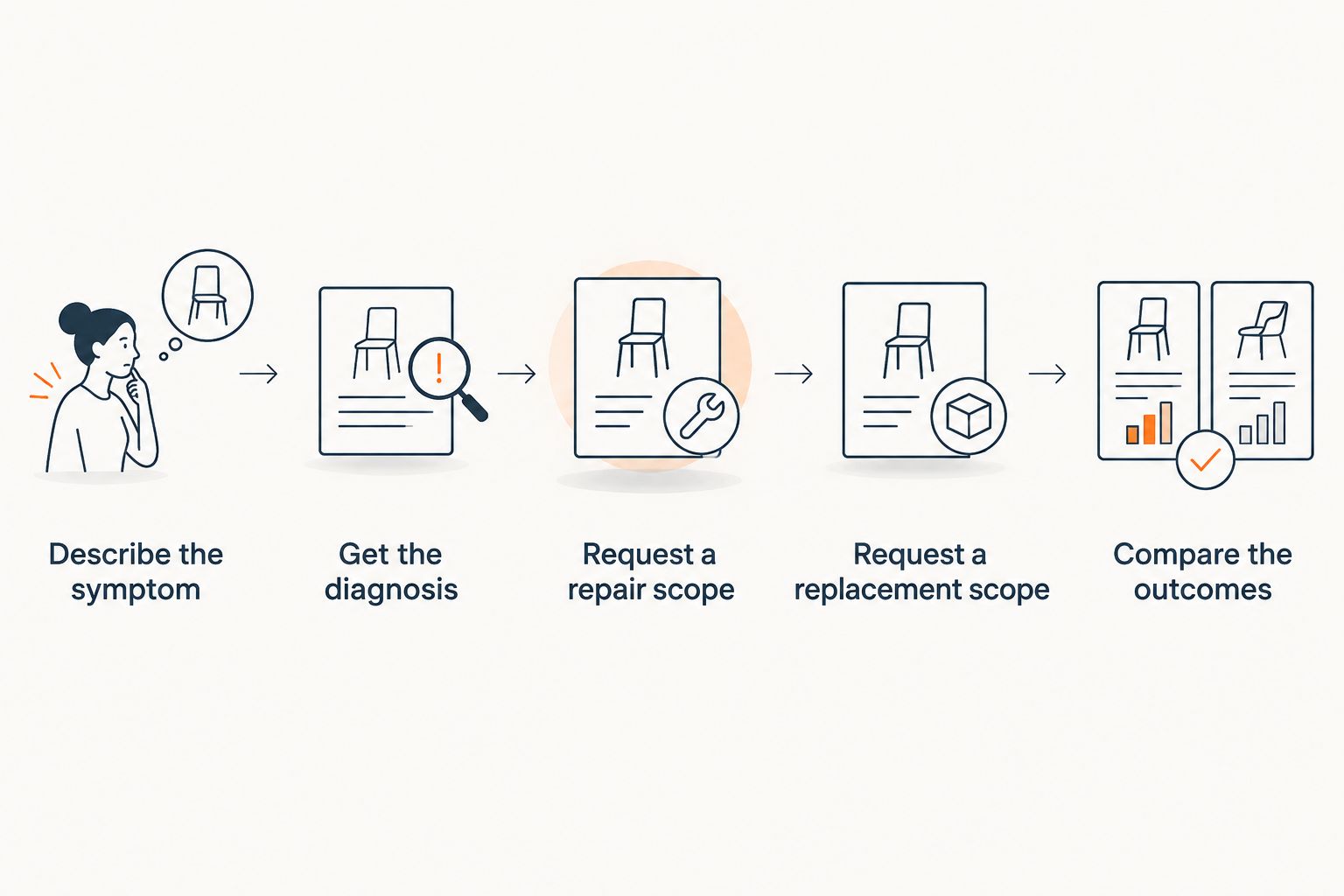
- Describe the symptom. Say whether the AC runs without cooling, stops running, cools unevenly or repeatedly breaks down. Report what you observe without naming a part you have not verified.
- Get the diagnosis. Ask which test or observation identifies the fault. If the cause is still unknown, a replacement recommendation is not yet an explanation of the problem.
- Request a repair scope. Ask what work is needed, what it addresses and whether any known problem remains afterward.
- Request a replacement scope if appropriate. Ask which components will change and whether the proposal addresses the cause of poor cooling.
- Compare the outcomes. Decide which proposal is most likely to restore dependable cooling for your space, not just which proposal has the shorter list of work.
In 2026, keep a copy of both written scopes. If the recommendations differ between contractors, compare their explanations of the fault and included work before comparing the proposals themselves. A proposal that does not identify what problem it solves gives you too little information to approve it.
West Heating & Cooling offers AC repair, installation and 24/7 emergency service in the Lake of the Ozarks area, including Camdenton, Osage Beach, Lake Ozark, Warsaw and Lebanon. West Heating & Cooling is best for local customers who need the fault diagnosed before choosing AC repair or replacement. The trade-off is that you still need a system-specific diagnosis; a service description cannot tell you which option your unit needs.
Can you make the decision without an inspection?
You can gather useful information, but you cannot identify every AC fault from the thermostat or the sound of the unit. Note whether the system starts, whether air comes through the vents and whether the problem affects the whole space or particular rooms. Those details help explain the complaint; they do not replace a diagnosis.
Check the thermostat settings and any filter you can access safely. If you find an obvious issue, correct it and see whether cooling returns. Do not open electrical compartments or handle refrigerant lines to test a theory. If you notice an electrical hazard, stop using the equipment and seek professional service.
For a lake property that sits unused between visits, record whether the complaint happens after a long absence or during regular use. The timing helps a technician investigate, but it does not prove a particular cause. Tell them what happened rather than assuming the AC needs replacing.
What should a written estimate tell you?
A repair estimate should identify the work proposed and the problem it is meant to fix. Ask whether any separate issue has been found and how operation will be checked after the repair. If the cause is uncertain, request an explanation of what further diagnosis is needed.
A replacement estimate should identify the equipment and installation work in its scope. Ask what happens to existing indoor equipment, outdoor equipment, controls and ductwork. If the original complaint was uneven cooling, ask how the proposal addresses that complaint specifically.
For either option, get clarification before approval if a phrase is too broad to tell you what will be done. The right comparison is between two stated outcomes, not a short repair description and a replacement proposal that leaves connected work unclear. That remains true in 2026 even if you need cooling restored urgently.
Does repeated AC repair mean replacement is cheaper?
No. Repeated repair calls are a reason to investigate the pattern, not proof that replacement is the cheaper choice. Ask whether the failures share a cause, whether past work fixed the diagnosed problem and what another repair would leave unresolved.
If separate repairs have restored the system but it still does not cool adequately, tell the technician both facts. If the same symptom keeps returning, show the previous service descriptions. That history helps distinguish a new fault from an unresolved one.
Is replacing the outdoor unit enough?
Not necessarily. The outdoor unit is only part of an AC system, so ask how the proposed replacement works with the indoor equipment and controls that will remain. A proposal should state exactly what is changing and why that scope addresses the fault.
Do not assume replacing more equipment is always better, either. The diagnosis and the compatibility of the proposed work should drive the decision, not the size of the proposal.
Should you replace an AC unit that still cools?
Not solely because it is old. If the unit cools the space and has no identified problem requiring replacement, ask what specific benefit the proposed change would provide. If it cools unevenly or runs without meeting your needs, request a diagnosis before deciding whether the equipment or another part of the system is responsible.
The 2026 answer depends on the unit in front of you. Age is context; observed performance and diagnosed condition are the evidence.
FAQ
Is it cheaper to repair or replace an AC unit?
Repair is usually the cheaper immediate option for a confirmed, isolated fault in an otherwise sound system. Replacement can be the better decision when damage is widespread or failures keep returning; compare written scopes for your unit.
How do I know if my AC needs replacing?
Your AC needs a replacement assessment when a diagnosis finds widespread damage, recurring failures or cooling problems a limited repair will not resolve. Ask which finding supports replacement and what the proposed work includes.
Should I repair an AC unit that is not cooling?
Get the cause diagnosed before approving a repair or replacement. A not-cooling symptom alone does not identify which part has failed or whether the equipment needs replacing.
Can an AC unit be repaired instead of replaced?
Yes, an AC unit can be repaired when a fixable fault is identified and the rest of the system can provide dependable cooling. Ask whether the repair addresses the cause as well as the failed part.
Does an old AC unit always need replacing?
No, age alone does not establish that an AC unit needs replacing. Its diagnosed condition, repair history and ability to cool the space are more useful for this decision.
Should I get a second opinion before replacing my AC?
Get another diagnosis if the replacement recommendation does not clearly explain the fault or the proposed scope. Give the second contractor the same symptom history and compare the explanations, not just the proposals.
Can a new AC unit fix uneven cooling?
A new AC unit is not a guaranteed fix for uneven cooling. Ask the contractor to identify why rooms differ and explain how the replacement proposal addresses that cause.
One last thing
A contractor can fix the part that stopped working and still leave the reason it failed untouched. Before you approve either option, ask: What caused this problem, and how will the proposed work address it? That question makes a repair quote more useful and a replacement recommendation easier to judge.
West Heating & Cooling serves residential and commercial customers around the Lake of the Ozarks. If your AC has stopped cooling, describe the symptom and ask for a diagnosis before deciding what to authorize.